If your hiring "method" is just a cluttered inbox, a mess of back-to-back Zoom calls, and a vague hope that "we'll know them when we see them," let's be blunt: you don't have a method. You're just managing chaos. It might feel productive, but this approach is quietly mortgaging your company's future with every single mis-hire.
Turns out there’s more than one way to hire elite talent without mortgaging your office ping-pong table.
Why Your "Process" Is Costing You a Fortune
Nobody sets out to create a hiring process that burns through time and money. It just… happens. You post a well-meaning job description, resumes flood in, and suddenly your calendar looks like a game of Tetris you’re destined to lose.
This isn’t just inefficient; it’s a systemic failure with massive, hidden costs. Before you can implement something new, like the a method for hiring, you need to diagnose the problem. And while there are many effective Shorepod's hiring solutions out there, they only work if you know what you’re trying to fix.

The Black Hole of Scheduling
That endless email chain trying to find a 30-minute slot for three different people? That’s not recruiting. It’s administrative busywork, and it’s a soul-crushing time-suck.
A staggering 67% of recruiters spend anywhere from 30 minutes to two hours just coordinating a single interview. Now, multiply that by the typical 3-5 rounds you run for one hire. You’re watching hours of your most valuable time vaporize before a single meaningful conversation even takes place.
The Danger of the 'Gut Feel' Interview
We've all been there. You have a great "coffee chat" with a candidate. They're charismatic, they say all the right things, and your gut screams, "This is the one!"
The problem? Your gut is a terrible predictor of actual job performance.
Unstructured, "gut feel" interviews are where bias thrives and objective data goes to die. They lead you to hire people you like, not necessarily the people who can actually do the job exceptionally well.
This approach often results in a team where everyone thinks and acts the same, killing the diversity of thought you need to actually innovate and grow.
Repetitive Screening Is Your New Full-Time Job
Hope you enjoy asking, "So, tell me about yourself" on a loop. With a traditional process, that’s basically what you’re signing up for.
These repetitive screening calls are the ultimate productivity killer. You ask the same basic questions, get slightly different versions of the same answers, and spend your days filtering for basic qualifications that a smarter system could handle for you.
Each of these bottlenecks adds up. They don't just waste your time; they frustrate great candidates (who have other options) and lead to costly hiring mistakes. This guide introduces The A Method for Hiring not as a minor tweak, but as a fundamental shift away from the chaos. It’s about trading busywork for a systematic approach that actually predicts performance.
Define the Win Before You Post the Job
Posting a job ad without knowing exactly what a win looks like is a recipe for disaster. It’s like launching a product without a roadmap. Sure, you’ll generate some buzz, but it will be from all the wrong people. This is the single biggest reason most hiring processes fail—right at the starting line.
If you’ve ever found yourself drowning in a sea of resumes, thinking, “None of these people get it,” the problem isn’t them. It’s you. You posted a vague, cookie-cutter job description asking for a "detail-oriented team player," and that’s exactly what you got: a pile of generic applications.
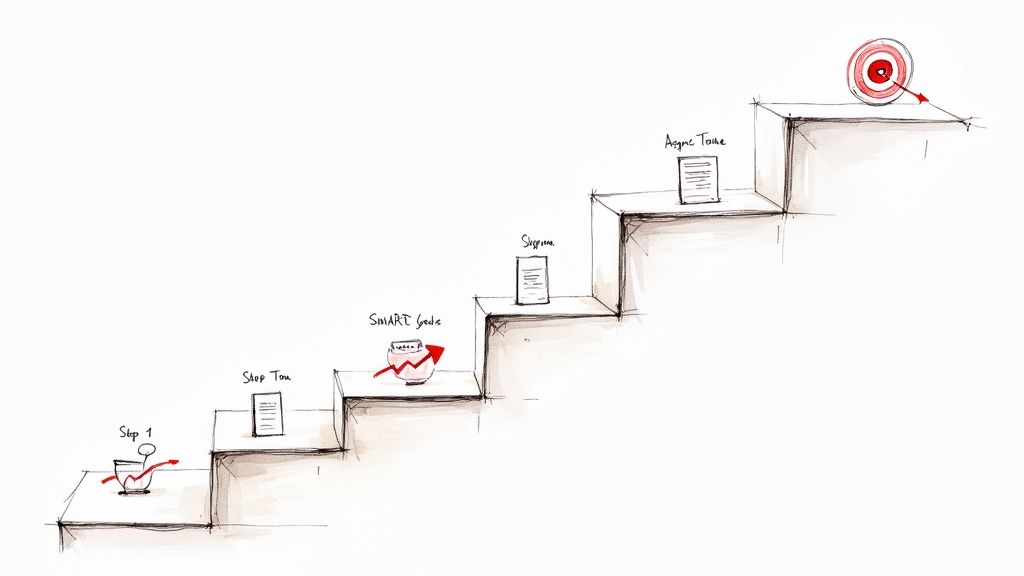
To break this cycle, the a method for hiring starts with one non-negotiable step: creating a Success Scorecard.

Ditch the Job Description Create a Scorecard
A job description lists responsibilities. A Success Scorecard defines victory. It’s a simple but incredibly powerful document that shifts your entire focus from a candidate's past experience to their future impact on your business.
Think of it as your North Star for the entire hiring process. Every interview question, every evaluation, and every decision gets anchored back to what actually matters. No more getting distracted by a candidate’s charm or a fancy Ivy League degree.
The scorecard forces you to answer the single most important question upfront: "What must this person accomplish in the next year to be considered a top performer?" If you can’t answer that with specifics, you are not ready to hire.
The Three Pillars of a Killer Scorecard
Your scorecard doesn’t need to be some complicated, multi-page document. In fact, simpler is better. Aim for a one-pager built on three core components:
- The Mission: A short, crisp statement explaining why the role exists. This is the job's elevator pitch. Think: "To build and lead our demand generation engine, transforming organic traffic into a predictable pipeline of qualified leads."
- Measurable Outcomes: This is the heart of the scorecard. List 3-5 specific, quantifiable results the new hire must achieve in their first 6-12 months. This is where you swap vague wishes for cold, hard goals.
- Core Competencies: These are the essential skills and behaviors needed to achieve those outcomes. Forget the laundry list. Pick the 5-7 abilities that are truly make-or-break for this role. You can learn more about how to develop these by exploring what a competency framework is.
Let's see this in action.
A Real-World Example Growth Marketing Lead
Imagine you’re hiring a Growth Marketing Lead. The lazy job description would ask for "5+ years of SEO experience" and "a proven track record." Yawn.
Let’s build a proper Success Scorecard instead.
1. The Mission
- "Own the top-of-funnel strategy to become the #1 organic voice in our niche, directly fueling sales with high-intent leads."
2. Measurable Outcomes (The "What")
- Increase qualified leads from organic search by 20% in the first six months.
- Achieve top-3 search rankings for 5 of our primary commercial keywords within one year.
- Reduce cost-per-acquisition (CPA) from paid channels by 15% by improving landing page conversion rates.
- Successfully launch and manage one new content marketing channel (e.g., podcast, video series) that generates 10 new SQLs per month by Q4.
3. Core Competencies (The "How")
- Data-Driven Decision Making: Doesn't just report on metrics; they interpret data to find actionable, game-changing insights.
- Strategic SEO: Thinks beyond basic keywords to the entire ecosystem of technical SEO, content strategy, and link acquisition.
- Project Management: Can independently own and drive complex campaigns with multiple stakeholders, keeping everything on track.
- Proactivity & Ownership: Identifies opportunities and runs with them without needing constant hand-holding.
- Clear Communication: Can easily articulate a complex marketing strategy to a non-marketing audience, like the sales team or the CEO.
See the difference? We're no longer hunting for someone who has just done marketing before. We are laser-focused on finding the person who can deliver these exact results. This scorecard becomes your blueprint, driving everything from your interview questions to your final decision.
Filter for Stars with Asynchronous Screening
Alright, you’ve built your Success Scorecard. You know exactly what a 'win' looks like for this role. Now comes the part where most hiring processes crawl to a halt: the endless, soul-crushing gauntlet of introductory phone screens.
This is where you reclaim your week. Instead of asking “so, tell me about yourself” on a painful loop, you’re going to implement an asynchronous video screening round. This isn't just about efficiency; it's a powerful filter that separates the genuinely interested candidates from the casual, "spray and pray" applicants.
If you’re still on the fence, consider this: the market for this kind of software is booming for a reason. It was valued at US$388 million in 2025 and is projected to hit US$583 million by 2032. This isn't some niche trend; it's a fundamental shift in how smart companies hire. You can discover more insights about the global market growth on qyresearch.in.
Crafting Questions That Actually Reveal Talent
The goal here isn’t to hear a candidate recite their resume. We're trying to get a preview of how they think, communicate, and solve problems. You want to craft 3-5 powerful questions that directly test for the core competencies you defined in your Scorecard.
Think less "What's your biggest weakness?" and more mini-case study. You're looking for proof of competence, not a perfectly rehearsed answer.
Here’s how to frame them, using our Growth Marketing Lead example:
- Test for Data-Driven Decision Making: "Walk me through a time you had to pivot a campaign strategy based on performance data. What was the situation, what did the data tell you, and what was the outcome?"
- Test for Proactivity & Ownership: "Imagine you're 30 days into this role. What's the first opportunity you'd tackle to make an immediate impact on our organic lead generation, and how would you start?"
- Test for Strategic SEO: "Our biggest competitor currently outranks us for our top commercial keyword. Give me a brief, high-level overview of how you would approach closing that gap."
These questions force candidates to move beyond generic fluff and demonstrate real-world thinking. Their answers will tell you more in five minutes than a 30-minute phone call ever could. For a deeper dive into the mechanics, check out our guide on how asynchronous video interviews work.
The Real Magic of Going Async
Let's be clear about what this step really accomplishes. It’s not just about saving time on scheduling (though, believe me, it saves a ton of time). It’s about elevating the quality of your entire pipeline.
First, it’s a commitment filter. The candidates who can’t be bothered to spend 10-15 minutes recording thoughtful answers probably weren’t that invested anyway. Good riddance. You've just weeded out the low-effort applicants without lifting a finger.
Second, it allows for better, less biased evaluation. Your team can review submissions on their own time, replay answers, and score them against the scorecard rubric without the pressure of a live conversation. This levels the playing field, focusing on the substance of their answers, not their interview-day charisma.
An asynchronous screen moves the first interaction from a logistical hurdle to a genuine assessment of skill and fit. It respects everyone's time—yours and the candidate's—and ensures that when you do get on a live call, it’s with someone who has already proven they're a serious contender.
Finally, it gives candidates a chance to shine on their own terms. Introverts, people in different time zones, and those with hectic schedules can present their best selves without the stress of a sudden, high-pressure call. It’s a more inclusive and modern first impression.
This single change—swapping repetitive phone screens for a thoughtful async round—is one of the most impactful parts of the a method for hiring. You’ll screen more candidates in less time, dramatically improve the quality of your finalists, and free your team to focus on what really matters: having deep, meaningful conversations with a small pool of absolute stars.
Conduct Interviews That Actually Predict Success
So, you’ve made it through the screening gauntlet. If you followed the steps, you’re looking at a small, highly qualified pool of candidates who have already proven they’re serious. Now it's time for the main event—the live interviews.
Let's be brutally honest, though. Most interviews are a complete waste of time. They’re unstructured, riddled with bias, and about as predictive of on-the-job success as a coin flip. The whole "let's just have a coffee chat and see if we vibe" approach is where even the most promising hiring processes go to die.
We're here to kill that approach. The next stage of the a method for hiring is all about running structured, competency-based interviews. Every single candidate gets the same core questions, all tied directly back to your Success Scorecard.
No more winging it. No more softball questions. This is how you shift from gut feelings and "I really liked them" to data-backed decisions that actually work.
The Three Interviews That Matter
Instead of a chaotic series of random conversations, we’re going to use a deliberate, three-part interview loop. Each stage has a very specific purpose, designed to vet the candidate from a different, crucial angle.
- The Deep Dive: This is the "prove it" interview. It’s usually with the hiring manager or a senior team member and is laser-focused on past results and a candidate’s technical or functional skills.
- The Peer Panel: Think of this as the "can we actually work with you?" interview. The candidate meets with 2-3 potential teammates to see how they handle collaboration, communication, and team dynamics.
- The Hiring Manager Interview: This is the final conversation. It’s all about vision, long-term alignment, and getting that final confirmation that this person can truly deliver on the role's core mission.
Before we even get to this stage, our async screening process does the heavy lifting to filter for the best fits.

This simple, three-step async process ensures that by the time candidates get to you, they're already pre-qualified, saving everyone a ton of time.
Let’s take a quick look at why this structured approach blows the old-school, "go-with-your-gut" method out of the water.
Traditional vs. Structured Interviewing
| Attribute | Traditional 'Go-With-Your-Gut' Interview | Structured 'A-Method' Interview |
|---|---|---|
| Questions | Unplanned, inconsistent, often based on resume-scanning in the moment. | Pre-defined, competency-based questions asked to every candidate. |
| Focus | Vague "culture fit," likability, and how the conversation "feels." | Specific evidence of past performance and required skills. |
| Evaluation | Subjective gut feelings ("I got a good vibe from them."). | Objective scoring on a pre-defined rubric tied to role outcomes. |
| Bias | Highly susceptible to affinity bias, halo effect, and other gut-based errors. | Systematically reduces bias by focusing on data and evidence. |
| Predictive Power | Low. Poor correlation with actual job performance. | High. Strong correlation with on-the-job success. |
The difference is stark. One method is a gamble; the other is a system. Now, let’s design the questions that fuel this system.
Designing Questions That Get Real Answers
Generic questions get you generic, rehearsed answers. If you want these interviews to work, you need questions that force candidates to give you specific, concrete evidence of what they can do.
For the Deep Dive, you’ll want to anchor your questions to past performance. Don’t ask, "Are you a good project manager?" That’s useless. Instead, ask this:
- "Tell me about the most complex project you ever managed. What were the goals, what went wrong, and what was the final result?"
When it comes to the Peer Panel, you’re digging into how they actually operate on a team. Forget "Are you a team player?" Try this:
- "Walk me through a time you had a significant disagreement with a colleague on a project. How did you handle it, and what was the outcome for the relationship and the project?"
And for that final Hiring Manager interview, you need to test their strategic thinking and alignment.
- "Based on what you know about our goals, what would you aim to accomplish in your first 90 days? What potential roadblocks do you see, and how would you address them?"
These questions aren't just conversation starters; they are precise data-collection tools.
Your Secret Weapon The Evaluation Rubric
This is the part that separates the pros from the amateurs. You absolutely need a simple evaluation rubric—a scorecard for the interviewers themselves. After each conversation, every single interviewer scores the candidate on a 1-4 scale for each core competency you defined in your Success Scorecard.
An evaluation rubric forces your team to justify their ratings with specific evidence ("The candidate provided a clear example of increasing leads by 20%…") instead of vague feelings ("They seemed really smart!"). This simple tool is your single best defense against hiring bias.
A score of "1" might mean "Strong Red Flag," while a "4" means "Exceptional Evidence." This simple act forces a disciplined, data-driven conversation later. It's no longer about who liked the candidate the most; it's about who most consistently demonstrated the required skills.
You can learn more by checking out our guide on the essentials of an interview score card.
By structuring your interviews and scoring every candidate against a consistent rubric, you systematically de-risk your entire hiring process. You end up with objective data points instead of subjective opinions, making your final decision obvious, defensible, and far more likely to be the right one.
Make the Offer and Secure Your Top Candidate
The interviews are over. Your team has met some incredible people. Now comes the most treacherous part of the entire hiring process: analysis paralysis.
This is the moment where good intentions and objective data get thrown out the window. It usually happens in a conference room, where the loudest person's opinion suddenly carries the most weight and "gut feelings" get treated like hard data. Before you know it, you're just debating who you liked the most. It's a disaster in the making.
But if you’ve followed this process, you have a secret weapon to prevent this exact meltdown: a neat stack of completed Evaluation Rubrics.
The Wash-Up Meeting: No Opinions Allowed
It’s time for what I call the "Wash-Up" meeting. Get every single person who interviewed the final candidates in a room (or a Zoom call). There's one critical rule for the Wash-Up: no one is allowed to say, "I really liked Sarah," or "I just didn’t get a good vibe from David."
All feelings are banned. Seriously.
Instead, you go around the room, competency by competency, and simply share the scores from the rubric.
The conversation instantly shifts. You’re no longer running a subjective popularity contest; you're conducting an objective review of the evidence. The central question changes from, "Who did we like?" to "Who most consistently demonstrated the required competencies across all interviews?"
When you lay the scores out side-by-side, the right choice is almost always staring you in the face. The candidate who consistently scored 3s and 4s on “Proactivity & Ownership” is your hire. The one who was charming but scored 1s and 2s on the skills that actually matter for the job is not. This makes the final decision obvious and, more importantly, defensible.
Crafting an Offer They Can’t Refuse
Alright, you’ve made your data-backed decision. Time to celebrate, right? Not so fast. The best candidates—the ones you just spent all this time finding—have options. They are almost certainly in the final stages with two or three other companies.
Moving quickly isn’t just a nice-to-have; it’s a competitive advantage. Slow companies get the candidates who are left over after the fast ones have hired the best talent. Your goal is to get from the final interview to a verbal offer in 24-48 hours.
When you call with the offer, don’t just lead with the numbers. A great offer sells the mission, not just the salary. Circle back to the Success Scorecard and remind them of the specific impact you believe they’ll have.
Try something like this:
- "We were all incredibly impressed with your approach to SEO strategy. We're confident you're the person who can help us hit our goal of increasing organic leads by 20% this year, and we want you to lead that charge."
This simple framing does wonders. It shows you were listening, reinforces that they are the solution to a critical business need, and makes it clear the role is about making an impact, not just filling a seat.
How to Reject Candidates Without Burning Bridges
This is the step everyone dreads and most companies completely botch. You have two other fantastic finalists who you’ve just invested hours in getting to know. Your response cannot be a generic, automated "thanks, but no thanks" email. That’s how you torpedo your employer brand.
For your silver and bronze medalists, you owe them a phone call. It’s a simple act of respect that pays off massively down the line.
During that call, do these three things:
- Be Direct and Grateful: Thank them sincerely for their time and tell them you’ve decided to move forward with another candidate. Don't beat around the bush.
- Give Genuine, Specific Feedback: This is your chance to turn a rejection into something positive. Use the data from the rubrics. "The team was really impressed with your project management skills. Ultimately, the decision came down to another candidate who had slightly more direct experience in B2B SaaS."
- Leave the Door Open: If they were a genuinely strong candidate, tell them. "You were a very strong contender, and I would love to stay in touch for future opportunities."
This five-minute phone call transforms a negative experience into a respectful, human interaction. You leave the candidate feeling valued, you protect your company’s reputation, and you start building a pipeline of pre-vetted talent for your next open role. It’s one of the highest-leverage things you can do in your entire hiring process.
Frequently Asked Questions About The A Method
You’ve got questions. I’d be surprised if you didn’t. A hiring method this structured sounds like a lot of work, and maybe a little too good to be true. I get it. Here are the most common questions I hear, answered straight up.
How Long Does It Really Take to Implement This Hiring Method?
Let's be honest: the upfront work is the heaviest part. The first time you build a Success Scorecard and map out your interview questions, you’ll probably spend a few focused hours getting it right. But that initial investment pays you back almost instantly.
Once you have your templates, you can spin up a complete, high-quality hiring process for a new role in less than an hour. Just think about that. You'll save dozens of hours on tedious scheduling and repetitive screening calls on your very first search. It’s the classic “slow down to speed up” scenario, and it works.
Does Asynchronous Screening Feel Impersonal to Candidates?
This is a fair question, but my experience shows the opposite is true—if you do it right. What’s actually impersonal is a rushed, 15-minute phone screen where a recruiter is just trying to check boxes. That feels transactional.
An async interview gives the candidate the floor. It respects their time by letting them craft thoughtful answers on their own schedule, without the pressure of a live call. It’s a far more engaging first step than getting a generic scheduling link for a call they have to squeeze between meetings.
This method signals that you value a candidate’s thoughtful input over their ability to perform on the spot. It sets a professional tone from the very first interaction.
This isn't just a theory; major companies have seen huge success. Chipotle, for instance, used AI-powered async interviews and saw their application completion rates jump from 50% to 85%. Even better, they cut their time-to-hire from 12 days down to just 4. If it works at that scale, it can definitely work for you. You can read more about these AI recruiting trends on onewayinterview.com.
Will This Method Work for Hiring Senior or Executive Roles?
Absolutely. In fact, it’s even more crucial for these high-stakes roles. While the async portion might look a little different for a C-level search, the core principles of the method are non-negotiable.
For an executive, the async round might be a brief strategic write-up or a quick pre-call with the CEO about a specific business challenge, not a video. The format can change, but the philosophy—getting structured, comparable data early—doesn't.
The Success Scorecard, the structured interviews, and the data-driven wash-up meeting are precisely what protect you from making a million-dollar hiring mistake. The goal is always to remove bias and predict performance, and that discipline matters most when the stakes are highest. This isn’t just a process; it's a system that scales from your first intern to your next VP.
Ready to stop managing chaos and start hiring top performers systematically? With Async Interview, you can implement the asynchronous screening part of this method in minutes. See how thousands of companies are hiring up to ten times faster. Start your free trial today.