Let's cut to the chase. You've heard the acronym 'ATS' thrown around, and if you're trying to hire anyone without losing your mind, it's the one piece of tech you absolutely must understand. Think of it as a hyper-organized digital filing cabinet for every resume that lands on your desk—only this one has a very strong, and sometimes very wrong, opinion.
So What Is An ATS, Really?
Alright, let's have a real conversation about this. "Applicant Tracking System" sounds like yet another expensive line item you have to justify in the budget, right next to the office kombucha tap. But what does it actually do for you day-to-day?
At its core, an Applicant Tracking System is software designed to bring some semblance of order to the absolute chaos of recruiting. Its main job is to take the hundreds—or thousands—of resumes you get and funnel them into a single, searchable database. No more drowning in an inbox full of PDFs named resume_final_final_v2.docx. The ATS becomes your command center.
It's a simple concept, but the execution is what matters.
ATS at a Glance: What It Is vs. What It Does
| Concept (What It Is) | Function (What It Does) |
|---|---|
| A centralized candidate database. | Collects applications from your career page, job boards, and employee referrals. |
| A system of record for hiring activity. | Stores and organizes candidate profiles, resumes, and every single touchpoint. |
| An automation engine for recruitment tasks. | Scans and parses resumes to yank out keywords like skills and experience. |
| A compliance and reporting tool. | Filters and ranks applicants based on how well they match your job description. Brutally. |
Essentially, an ATS is the system that makes all the individual hiring actions manageable. It’s what separates a scalable hiring process from just… winging it.
Why You Can’t Afford to Ignore It
Think this is just for the corporate giants with armies of recruiters? You're missing the point. The average corporate job post attracts a jaw-dropping 250 resumes. Screening those by hand is a recipe for burnout and bad decisions. It’s no wonder that while nearly 99% of Fortune 500 companies use them, so do 60% of small businesses. If you want to nerd out on the numbers, you can find more of these recruitment statistics here.
The reality is, an ATS isn't a luxury anymore; it’s a necessity if you want to grow your team without mortgaging the office ping-pong table. It handles the initial grunt work, freeing you up to do what technology can’t: connect with actual human beings.
Here’s the unfiltered truth: An ATS is your first line of defense against chaos. It’s an automated assistant, a compliance watchdog, and—if you aren’t careful—a black hole where great candidates go to die.
A solid ATS should:
- Parse and Scan: It automatically reads resumes, pulling out details like skills and work history into a clean profile. Emphasis on should.
- Filter and Rank: It scores candidates against your job description, bubbling the most promising matches straight to the top.
- Track and Communicate: It keeps a record of every touchpoint, from the application to the offer letter, so you don't look like you have no idea what's going on.
In short, it’s the engine that powers your hiring machine. Now, let’s dig into how that engine actually works. Or doesn't.
How an ATS Actually Works Behind the Curtain
So, what really happens after a candidate clicks that ‘Submit’ button? It’s not magic, but it’s definitely a complex—and often messy—process. Think of it less like a mailbox and more like a digital bouncer at an exclusive club, with a very specific, and sometimes baffling, guest list.
First up is a process called resume parsing. The ATS takes the resume file, digitally dissects it, and tries to pull out key information: name, contact details, work history, skills, education. It then stuffs this data into standardized fields. This is exactly why those ultra-creative, multi-column resume layouts can backfire spectacularly. The parser gets confused, and suddenly your list of skills is listed as your previous employer. Oops.
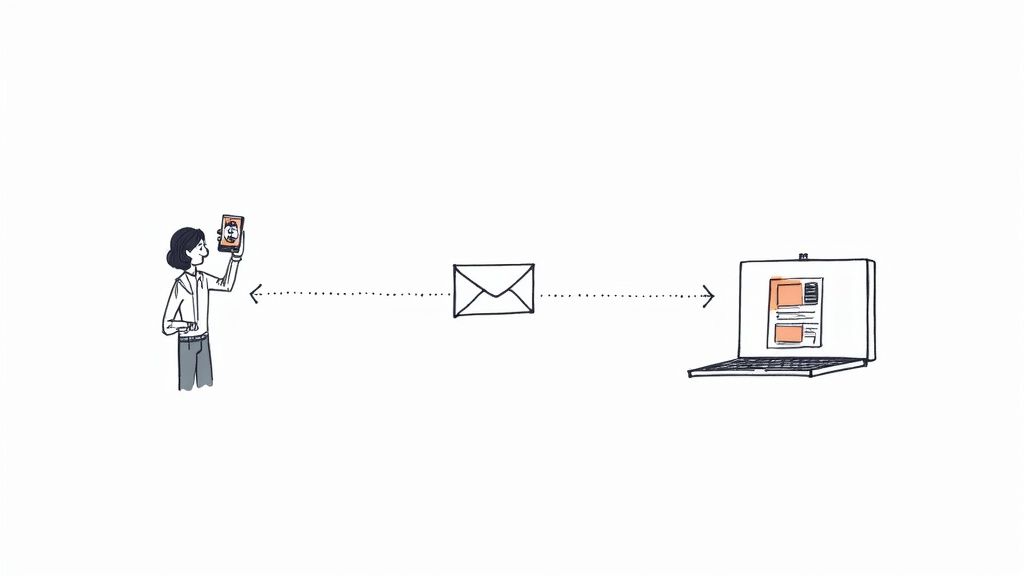
This graphic gives you a bird's-eye view of that journey.

As you can see, the ATS is the ultimate gatekeeper. It’s built for organization, sure, but its primary function is often elimination.
The Keyword Matching Game
Once the candidate’s information is filed away (correctly or not), the real test begins. The ATS meticulously compares the text from the resume against the keywords baked into your job description. It’s a completely literal, no-nuance comparison.
If your job post asks for a "Project Manager" and a candidate's resume says "Program Lead," the system might flag it as a mismatch and tank their score. It’s a brutal, unforgiving game of word matching.
Here's the inside scoop: An ATS has zero understanding of context. It's like a bouncer checking an ID, not a seasoned recruiter who can read between the lines and spot transferable skills. It’s searching for exact phrases, not the spirit of the experience.
This matching process spits out a score for every applicant, ranking them from "most qualified" to "least qualified" in the system's robotic opinion. Your recruiters then see a dashboard with names neatly lined up next to a percentage score. So scientific.
The Infamous Knockout Questions
But the filtering doesn't stop there. Many ATS platforms deploy knockout questions—a series of yes/no or multiple-choice questions at the start of the application. Get one "wrong," and you're out. Instantly.
- "Are you legally authorized to work in this country?"
- "Do you hold a current PMP certification?"
- "Are you willing to relocate to Anchorage, Alaska in the middle of winter?"
A candidate who selects the predetermined "wrong" answer is automatically archived. Their profile likely never even lands in front of a human. While this is an undeniably efficient way to narrow the field, it’s a blunt instrument. Be careful how you configure these questions and other forms of recruitment automation software, or you risk tossing out some real gems by accident.
In the end, the ATS is designed to take a mountain of applications and shrink it down to a manageable hill. The trick is making sure the right people are still on that hill when the dust settles.
The Real Reasons Smart Companies Use an ATS
Let's be real for a second. For all the chatter about keyword traps and resume black holes, you simply can't scale a company without an Applicant Tracking System. Drowning in a sea of PDFs and forgetting who you talked to last Tuesday isn't a growth strategy—it's a recipe for total chaos.
So why do smart founders and HR leaders swear by them, even with the occasional headache? It’s not about buying fancy software. It's about buying back your time and your sanity.
The End of Spreadsheet Hell
Before we had an ATS, our hiring "system" was a horrifying mix of a shared spreadsheet, flagged emails, and frantic Slack messages. "Did anyone talk to the candidate from Acme Corp?" was a daily, anxiety-inducing question.
An ATS puts a permanent end to that madness.
It creates a single source of truth for your entire team. Every resume, every note, every scrap of feedback lives in one unified profile. No one is stepping on each other's toes or—worse—interviewing the same candidate twice without realizing it.
An ATS is your company's collective memory for hiring. It stops good candidates from falling through the cracks and prevents your team from looking like a disorganized mess.
Compliance Without the Headaches
Here's the part nobody loves to talk about but everyone needs to handle: compliance. Hiring laws, data privacy (hello, GDPR), and data retention policies are a legal minefield. Trying to manage this manually is like trying to defuse a bomb while juggling chainsaws.
A proper ATS automates a huge chunk of this. It can handle data consent, track Equal Employment Opportunity (EEO) info anonymously, and enforce data retention rules without you thinking about it. It’s the unglamorous but critical function that keeps you safe while you focus on finding great people.
The Real ROI Is Speed and Quality
When it comes down to it, the biggest wins are all about efficiency. An effective ATS gives your team superpowers. Recruiters consistently report game-changing results, with 86% saying their ATS slashed their time-to-hire and 94% noting a positive shift in their entire hiring process.
Some systems can cut the hiring cycle by a staggering 60%, moving from job post to offer in weeks, not months. You can dive into more of these numbers and see the full impact an ATS has on recruitment.
But it’s not just about being faster; it’s about being better. A massive 79% of ATS users report an improvement in the quality of their hires.
Why? Because when you’re not buried in paperwork, you have more time for the human element: sourcing great people, conducting thoughtful interviews, and selling them on your vision. Smart companies pair their ATS with proven recruiter tips to hire top talent, creating a process that's both seamless and effective.
Simply put, an ATS moves hiring from a chaotic chore to a strategic function. It’s the backbone of any modern hiring machine.
The ATS 'Gotchas' That No One Talks About
Alright, let's have some real talk. An ATS isn't a magic wand you wave over your hiring process. If you just plug it in and walk away, you’re not fixing your process—you’re just automating your mistakes at scale.
This is the part of the story the sales reps tend to leave out.
Let's start with the biggest pitfall.

The Keyword Trap
The most dangerous flaw in any ATS is its blind devotion to keywords. An ATS has no clue about nuance, context, or synonyms. It’s a robot playing a high-stakes game of "match the phrase," and it will cost you incredible talent.
Imagine you’re hiring a sales manager. Your job description asks for "team leadership." A rockstar candidate who led a top-performing team for five years writes that they "managed a team of 10 sales reps." To the ATS, that's a mismatch. Their score drops, they sink to the bottom of the pile, and a human probably never even sees their name.
This isn't a theory; it happens every single day. The data shows that up to 75% of all resumes submitted are never seen by a real person, largely because they fail this unforgiving keyword scan.
When you rely only on keyword matching, you risk hiring the person who's best at gaming your system, not the person who's best for the job.
The Cold, Robotic Candidate Experience
For many candidates, your application process is their first interaction with your brand. An out-of-the-box, unconfigured ATS can make your company feel sterile, impersonal, and—let's be honest—like you just don't care.
Think long, clunky forms, a total lack of communication after they hit "submit," and rejection emails that sound like they were written by a robot. It’s a terrible first impression.
A bad candidate experience has real consequences:
- Top talent will bail. The best candidates have choices. They won't suffer through your frustrating hoops.
- Your brand reputation takes a hit. Unhappy candidates talk. They share their horror stories on social media, tarnishing your employer brand.
- You could lose customers. Your candidates might also be your customers. A bad application experience can turn them away from your product for good.
The Integration Nightmare
And finally, the integration headache. The sales pitch probably promised seamless connection to your calendar, email, and video interview platform.
The reality? You can spend weeks just trying to get everything to talk to each other, only to discover the "integration" is a glorified data dump that creates more manual work.
This isn't about bashing the technology. It’s a warning. An ATS is a powerful tool, but it's only as smart as the person setting it up. You have to actively manage it to boost—not replace—your team’s judgment.
Moving Beyond Resumes with Video Interviews
Let’s be honest. Your ATS is a fantastic digital filing cabinet. It’s a lifesaver for organizing and keeping your team from drowning. But as a judge of character, passion, or communication skills? It’s terrible.
An ATS is programmed to scan for keywords; it can’t see a spark of potential. We ran into this wall ourselves. We were finding candidates who looked perfect on paper but fell completely flat in person. Their resumes were perfectly optimized, but their personalities just weren't the right fit. It was time for a change.

From Keywords to Candidates
The smartest companies now pair their ATS with tools like asynchronous video interviews. The workflow is simple but incredibly effective: the ATS handles the initial flood, filtering out anyone who doesn’t meet the non-negotiable hard skills. Then, you invite the top matches to a one-way video interview.
This isn't tacking on another step. It's replacing one. Instead of scheduling dozens of repetitive, 15-minute phone screens, you get rich, reviewable video responses you can watch on your own time. You actually get to see the person behind the resume—their energy, how they articulate their thoughts, and whether they genuinely light up when talking about their work.
This is how you find those hidden gems and culture fits that a cold, keyword-driven ATS would have completely missed. We're not saying we're perfect. Just more accurate more often. (Toot, toot!) You can take a closer look at our deep dive into the benefits of pre-recorded video interviews.
Hire Faster and Smarter
Combining an ATS with video interviews creates an efficiency powerhouse. For distributed teams and agencies handling high-volume hiring, a staggering 85% of recruiters now use tech like video interviewing to slash their time-to-hire. When you can screen 10 video submissions in the time it takes to schedule and complete just three phone calls, you're not just moving faster—you're working with much better information. As you can see by exploring the latest hiring technology trends on RecruitCRM.io, the impact is massive.
This isn’t about replacing your ATS. It's about augmenting it. You let the machine handle the paperwork and let the humans focus on what they do best: connecting with other humans.
This two-pronged approach gives you the best of both worlds:
- ATS for Volume: It efficiently manages the high quantity of inbound applications.
- Video for Quality: It quickly surfaces the high-quality candidates who have the soft skills and personality to thrive on your team.
You’re still answering the core question of "what does ATS mean" for your process—it means you have a powerful filter. But now, you’re adding a crucial next step that actually identifies real talent, not just someone who checks boxes. It’s the difference between building a team and just filling a seat.
Your No-Nonsense ATS Playbook for 2026
Alright, enough theory. Let's talk about what really matters: making these systems work for you, not the other way around.
This is your practical guide for navigating Applicant Tracking Systems in 2026. Whether you're hiring or looking for a job, understanding the ATS is key to winning the game.
For Recruiters and Founders
Think of your ATS as a powerful assistant, not a replacement for your judgment. If you just flip the switch and walk away, you’re letting a robot make your most important people decisions. A robot that can’t tell a great candidate from someone who just knows how to stuff a resume with keywords.
- Write job descriptions for humans. Forget the buzzwords. Focus on what someone will actually do. A clearer job description naturally attracts better fits from the start.
- Be thoughtful with your filters. If your "must-have" list is too rigid, you'll screen out amazing people with diverse backgrounds. Take a hard look at your knockout questions—are they really weeding out the unqualified, or just those with an unconventional career path?
- Audit the discard pile. Every so often, peek at the resumes your ATS rejected. If you find hidden gems, it’s a glaring sign your settings need a tune-up.
Picking the right platform can feel monumental. To help you cut through the marketing noise, we put together a guide on the best applicant tracking systems for small businesses.
For Candidates
Pay attention, because this is important. The biggest mistake you can make is sending the same resume for every application. That beautifully designed, two-column resume you spent hours on? It's likely getting scrambled into gibberish by the ATS parser and rejected before a human ever lays eyes on it.
Here’s the unfiltered advice: Keep it simple. A clean, single-column resume using a standard font is your safest bet. Save it as a .docx or .pdf. Don’t give the bots a reason to toss your application on a technicality.
To get past the gatekeeper, you need a strategy. For a truly deep dive, you'll want to learn how to pass every ATS CV test, especially when the competition is fierce.
Your must-do list:
- Mirror keywords—ethically. Look at the job description and use the exact phrasing for important skills. If it asks for "team leadership," use those exact words. Don't assume "managed a team" will do the trick.
- Steer clear of headers, footers, and tables. Many systems can't read text in these fields. That means your contact info or most impressive skills could completely disappear.
- Spell out your acronyms. Always write out the full term first, then put the acronym in parentheses, like "Master of Business Administration (MBA)." This ensures you show up whether the recruiter searches for the full phrase or just the abbreviation.
This isn't about tricking the system. It's about making sure your skills and experience actually get seen, giving you a fair shot.
Frequently Asked Questions About ATS
We’ve unpacked a lot, but I’m sure a few questions are still lingering. Let's get right to them—no jargon, just straight answers.
Can An ATS Accidentally Reject A Good Candidate?
Unfortunately, yes. It happens more often than you'd think. An amazing candidate might have the perfect background, but if their resume isn't loaded with the exact keywords from your job description or uses a fancy format the system can't parse, it can get tossed.
An ATS can't read between the lines. That's precisely why your team's oversight is non-negotiable. Think of the ATS as a filter, not the final judge.
Is An ATS Expensive for A Small Business?
The pricing is all over the map. You can find modern platforms for small teams with surprisingly affordable monthly plans. On the other end, enterprise systems can easily cost more than your office rent.
The key isn’t to buy the system with the most bells and whistles. It’s to find one that fits your hiring volume and budget. Don't pay for features you’ll never use.
How Is An ATS Different from A CRM?
This one trips people up, but the difference is simple.
- An Applicant Tracking System (ATS) is for managing active job applicants—people who have applied for an open role. It's a workflow tool for moving candidates from application to offer.
- A Candidate Relationship Management (CRM) system is for nurturing relationships with potential candidates—people you’ve sourced who might be a great fit later on. It’s a pipeline-building tool.
The smartest companies use both. An ATS manages the now; a CRM builds the future.
Ready to move beyond keyword-matching and see who your best candidates really are? Async Interview helps you replace repetitive phone screens with rich, one-way video interviews, so you can hire better talent up to ten times faster. See how it works and start your free trial at https://asyncinterview.io.