Alright, let's settle this once and for all. Can you bring notes to an interview?
The short answer is yes, absolutely. But that’s the wrong question. The real question is how you do it without looking like you’re cramming for a final exam five minutes before it starts.
Yes, You Can Bring Notes To An Interview. Now Let's Talk About How Not to Screw It Up.

From my seat in the hiring trenches, I’ve seen this debate rage for years. What was once seen as a crutch is now—when done right—a signal of a prepared candidate.
Of course, showing up with a dog-eared, five-page script is a surefire way to get a polite "we'll be in touch." But arriving with a few strategic bullet points? That screams confidence, preparation, and respect for my time.
It's not about finding a crutch; it's about building a springboard. Your notes are there to remind you of that killer statistic you uncovered or that one sharp question that shows you’ve done more than just skim the company's homepage.
The New Standard of Preparation (Don't Get Left Behind)
The old-school fear of looking unprepared by using notes has completely flipped. Bringing notes has gone from a sign of weakness to a signal that you're a serious player. Think of it this way:
| Outdated Fear | Modern Reality | What It Really Signals to Me |
|---|---|---|
| "I'll look like I don't know my stuff." | Using notes as a reference, not a script. | You're organized and you value accuracy. |
| "It's a sign of weakness or poor memory." | It's a sign of thorough preparation. | You take this opportunity—and my time—seriously. |
| "The interviewer will think I'm cheating." | An interviewer worth their salt sees genuine interest. | You're proactive and you've actually done your homework. |
This isn't just my opinion; the data backs it up. It’s a smart move to think of your notes as your personal job interview cheat sheet.
Hiring managers are actually starting to expect this. A 2025 survey found that 68% of hiring managers were more impressed by candidates who came with prepared questions, seeing it as a clear signal of genuine interest. You can get more context on that over at mgma.com.
The modern interview isn't a memory test; it's a professional conversation. Arriving prepared with talking points shows you're treating it as such.
This shift is even more obvious with the rise of asynchronous interviews. With platforms like ours, where you record responses on your own time, a quick glance at your notes is just… smart.
In fact, LinkedIn's 2026 talent report showed that in these formats, candidate preparation scores shot up by 42% when notes were permitted, leading to better shortlisting rates. (Toot, toot!)
So, let's dismantle that old fear. Bringing notes isn't weakness—it's the swagger of a candidate who did the work and isn't afraid to prove it.
How to Craft Interview Notes That Don't Suck
Okay, we've established that bringing notes is a power move. But what should they actually look like? This isn’t your chance to print your entire life story in 8-point font. Think of your notes as a one-page "greatest hits" album—clean, scannable, and designed for a quick glance, not a deep read.
The whole point is to have a document that jogs your memory, not a script you perform. You want to look like a prepared strategist, not a student cramming for finals. This is how you turn nervous rambling into focused, data-backed brilliance.
Your Brag File, with Numbers
First things first: your brag file. This is no time for modesty. Vague statements like “I’m a good marketer” go straight to the shredder. You need to get specific with your accomplishments.
Use simple bullet points to list your top achievements, and make sure every single one is backed by a hard number. It’s the difference between saying you’re a great teammate and actually proving it.
Instead of: "Improved content strategy"
Try this: "Grew organic user base by 40% in Q3 by launching a targeted content strategy."
Instead of: "Helped with sales"
Try this: "Exceeded my Q2 sales quota by 18%, contributing to a $250K team revenue increase."
This section is your proof. It’s what you’ll glance at when the interviewer inevitably asks, “So, tell me about a time you succeeded.” No fumbling, just facts.
Prompts for Your Story, Not a Script
Next, you need a few prompts for your "Tell me about yourself" story. This is your opening, your elevator pitch. Winging it is professional suicide. But don't write out a full paragraph—that just encourages you to read it aloud like a robot. Stick to powerful keywords or short, punchy phrases.
The most effective interview notes are a safety net, not a teleprompter. They exist to prompt your best stories, not to be read word-for-word. A quick glance should be all you need.
Your prompts could look something like this:
- Origin Story: "From finance to tech…"
- Key Skill: "Data-driven decisions…"
- Big Win: "That 40% growth project…"
- Why Here: "Connect my skills to [Company]'s mission…"
Questions That Prove You're an A-Player
Finally, get a list of sharp, insightful questions ready for them. This is what separates a candidate who just wants a job from one who wants this job. It shows you’re interviewing them just as much as they’re interviewing you.
Skip the tired, generic questions like, "What's the company culture like?" Go deeper. Ask things that prove you've done your homework and are already thinking three steps ahead. Bringing well-researched notes shows an initiative that positively sways 72% of interviewers, especially when those notes include targeted questions about the role and company. For more on this, check out the complete guide from Indeed.com.
A lot of these questions will also help you frame your answers to behavioral questions. To get a head start, you might want to look at our guide on how to use the STAR method for interview questions.
Adapting Your Notes for Any Interview Format (Because They're Not All the Same)
The type of interview you're walking into changes everything. A face-to-face meeting, a live video call, and an async recording are completely different animals. Your notes need to play by the right rules for each.
Let’s be real. Pulling out notes in an office requires a different kind of finesse than glancing at a second monitor during a Zoom call. Get it wrong, and you look clumsy. Get it right, and you look like a pro who came to play.
In-Person and Live Video Interviews: The Art of the Glance
For a classic, face-to-face interview, it's all about etiquette. Don't hide your notes like a state secret. Instead, place your single, clean sheet of paper or a professional notebook on the table. Own it.
When you need a reminder, reference it with confidence. A simple, "Do you mind if I refer to a few key points I prepared?" works wonders. This frames you as organized, not nervous. The goal is a quick glance to jog your memory—not to read a script.
On a live video call, you’ve got more cover, but also more ways to mess up. The trick is positioning your notes so you can reference them without breaking eye contact or looking shifty.
- The Split Screen: Open your notes in a slender window right next to your video call app. This lets you see both at once.
- Window Placement: Drag the video call window as close to your webcam as you can. When you look at the interviewer, your eyes will still be aimed near the camera.
- The "Forehead" Sticker: My personal favorite. A small sticky note with your three most critical bullet points stuck just above your webcam. A low-tech hack that keeps your eyes where they need to be.
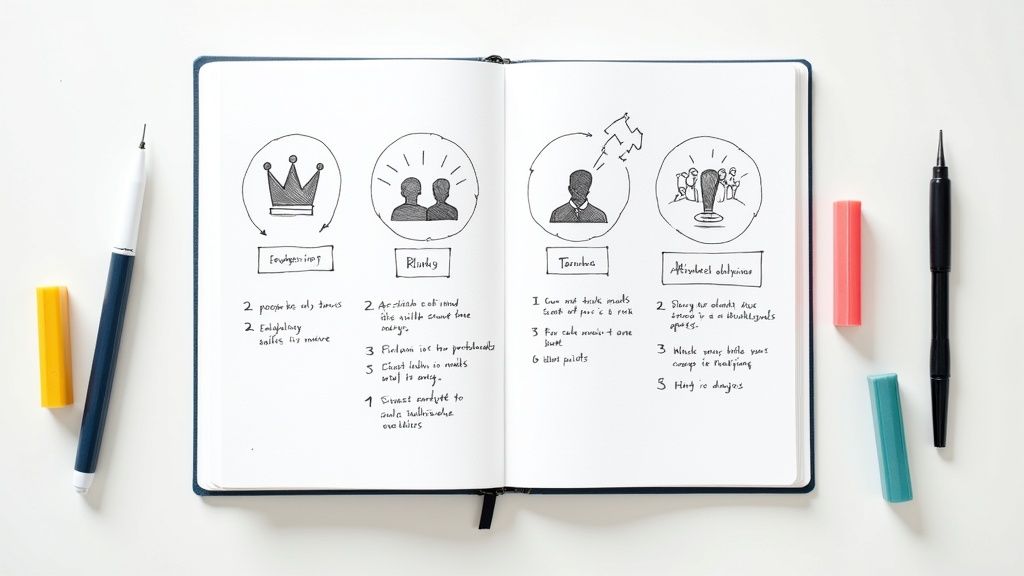
To help structure your notes, focus on three core components: your brag file, key story prompts, and your questions for them.

These three pillars give you a scannable, high-impact reference sheet that works beautifully in any live setting.
Your Secret Weapon: The Asynchronous Interview
And then there's the asynchronous video interview—what I consider a candidate's new unfair advantage. With platforms like Async Interview, you’re on your own turf, recording answers on your own time. This format completely rewrites the rules.
You can learn more about what a video interview entails in our dedicated guide.
In an asynchronous interview, there’s no one watching you live. This gives you total freedom to reference your notes openly, crafting polished, metric-driven answers that make the recruiter’s job easy. It's like an open-book test for your career.
Feel free to have your notes right on your screen, taped next to the camera, or spread out on your desk. This setup lets you nail every key metric and structure your answers perfectly, all without the fear of drawing a blank. It’s the best way to make sure all your hard work and preparation actually shine through.
An Insider's Guide to Using Interview Notes (From the Other Side of the Table)
Alright, let's flip the table and look at this from my chair. I’ve seen it all—the good, the bad, and the so-awkward-I-wanted-to-hide. When a candidate pulls out notes, it can be a brilliant move or a total train wreck. There’s rarely an in-between.
The difference? Execution. A candidate fumbling with a crumpled, multi-page mess looks lost. But one who confidently places a single, clean sheet on the table? They look like a strategist.
The Recruiter's Honest Dos and Don'ts
Forget the generic advice. Here’s what actually matters when you use notes in front of someone who makes hiring decisions for a living. It’s not just about looking prepared; it’s about avoiding the subtle red flags that sink your chances.
Here are the real ground rules:
- DO keep it to one page. Anything more feels like you're leaning on a script, not your own brain. This is your cheat sheet, not a novel.
- DO use it as a quick prompt. A glance down to remember a specific metric or a question is fantastic. It shows you care about accuracy.
- DON'T read from it like a robot. The second you read verbatim, you kill all rapport. It makes you sound disingenuous and shatters the conversational flow. Dead on arrival.
- DON'T try to hide it. Sneaking glances at notes on your lap is way more distracting than just putting them on the table. Own it.
The moment you ask for permission, you reframe the interaction. It stops being a secret crutch and becomes a professional tool you’re using to make the conversation better for everyone.
To pull this off gracefully, try this as you get settled: "I've prepared a few key points and questions to make sure we make the most of our time. Do you mind if I refer to them?" In all my years, I have never seen a recruiter say no.
And this isn't just for candidates. Did you know that interviewers who take notes can improve their decision-making accuracy by as much as 55%? It’s proof that preparation on both sides leads to better outcomes. You can see more on this in this in-depth hiring playbook from jacobian.org.
In asynchronous formats, this becomes even more critical. Well-prepared notes are an absolute game-changer. For more on that, check out these tips for your pre-recorded video interview.
Your Final Checklist: Don't Fumble at the Goal Line

You’ve put in the work. Your notes are dialed in, your wins are locked and loaded, and you’re ready for whatever interview format they throw at you. Now for the final pre-game huddle.
This isn’t just a recap. It's your last-minute walkthrough to ensure a small, preventable snag doesn’t derail all your strategic work. Trust me, you don’t want a dead webcam or a crumpled shirt to be the reason you stumble.
The Gear and Setup Check
Think of this as your pre-flight inspection. Whether you’re walking into their office or logging on, your setup has to be seamless.
- For Video Calls: Test your camera, mic, and internet. Give your background a final scan for anything distracting (yes, that pile of laundry counts). Have your notes open and do a quick run-through of the glance-and-speak technique.
- For In-Person: Print a fresh copy of your one-page notes. Don't pull a crinkled sheet from your bag. Place it in a professional portfolio. And for the love of all that is holy, bring a pen that actually works.
The goal is to eliminate all friction on game day. Your only job should be to have a great conversation, not to troubleshoot a faulty mic.
The Mental and Physical Prep
This is what separates the pros from the candidates who just show up. You’re not just showing up; you’re showing up to win.
The Night Before:
- Lay out your entire outfit. No last-minute panic.
- Do one final, quick scan of your "brag file" points.
- Get some real sleep. Seriously. All-nighter cram sessions are for college kids, not professionals.
The Hour Before:
- Stop cramming. The work is done.
- Do a quick power pose or listen to a song that gets you fired up. It sounds cheesy, but it works.
- Review the names and titles of everyone you’re meeting. Calling the hiring manager by the wrong name is a classic, avoidable mistake.
This isn’t about memorizing more facts—it's about getting your head in the game. You've already answered "can you bring notes to an interview?" with a confident "yes." Now you're ready to walk in—or log on—knowing you've done everything in your power to nail it.
Still have a few nagging 'what ifs' about bringing notes to your interview? It's normal. The idea can feel like walking a tightrope—get it right, and you look like a genius; get it wrong, and… well, it’s just awkward.
Let's cut through the uncertainty. Here are straight-up answers to the most common worries I've heard over the years. No fluff, just what I’ve seen work (and what I've seen crash and burn).
Is It Unprofessional to Look at My Notes During an Interview?
Not if you do it right. Honestly, the line between a professional power move and a rookie mistake is clear: glancing is professional, reading is not.
Your notes are a safety net, not a script. A quick, casual look down to grab a specific number—"I wanted to get this right, we increased lead conversion by 35%"—shows you're committed to accuracy. That’s a sign of confidence.
What doesn't work? Staring at your paper for an entire answer. That breaks all connection and comes across as a serious lack of confidence. My rule of thumb: maintain eye contact at least 80% of the time. Let your notes guide you, not hijack the conversation.
Should I Use a Tablet or My Phone Instead of Paper?
My advice? Absolutely not. Just don't.
I know we live in a digital-first world, but in a live interview, pulling out a phone or tablet is like walking through a minefield. The interviewer has no idea if you're checking notes or a text from your friend. It puts up a psychological wall between you.
For any live interview—in-person or video—a single sheet of paper or a professional notebook is the only safe bet. It's a classic for a reason.
The only exception is an asynchronous video interview. Since you're in control of the recording environment, having digital notes on your screen is perfectly fine. No one will ever know.
What if the Interviewer Seems Annoyed I Brought Notes?
People worry about this, but in my experience, it's extremely unlikely. Most modern hiring managers will see it for what it is: a clear sign of serious preparation.
If you're still nervous, your intro is the perfect time to address it. A simple, confident statement like, "I've prepared a few notes to help keep our conversation focused and to remember some questions I have for you. I hope you don't mind if I refer to them," frames it perfectly.
And let's be real: if an interviewer has a problem with that level of organization, it might tell you something important about their company culture. You're interviewing them, too.
How Are Notes Different for an Async Interview?
This is where your notes go from a helpful tool to an absolute superpower. In a one-way video interview, there's no live audience and zero pressure to perform on the spot.
You can have your notes right next to your camera or open in a document on your screen. This lets you nail every single key metric, perfectly structure your STAR-method answers, and deliver a polished response without your mind going blank. It completely levels the playing field.
It’s your chance to give the company your best self, not just your best guess under pressure.
Ready to turn your interview prep into an undeniable advantage? At Async Interview, we’ve built a platform that lets you shine on your own terms. Our asynchronous video interviews give you the time and space to use your notes, craft thoughtful responses, and show recruiters exactly what you're made of. Say goodbye to interview anxiety and hello to your next great role. Check out how we're changing the hiring game.