Alright, let's be blunt. The phrase ‘adverse impact’ sounds like something your lawyer says right before sending a very expensive bill. And you’re right to be jumpy. In simple terms, the adverse impact definition is this: a piece of your hiring process, even one with the purest intentions, is accidentally kicking qualified candidates from a protected group to the curb at a much higher rate than everyone else.
So, What Exactly Is Adverse Impact?
Nobody wakes up and thinks, "Today, I'm going to build a discriminatory hiring process!" You're just trying to find good people. But here’s the kicker: adverse impact has nothing to do with your intentions. It's not about proving you meant to be unfair. It’s all about the cold, hard outcome.
Think of it as a hidden bug in your company's hiring code. The interface looks great, but underneath it’s quietly creating a lopsided team without setting off any alarms.
This whole mess was officially outlined in the Uniform Guidelines on Employee Selection Procedures way back in 1978. It was really cemented by the landmark 1971 Supreme Court case, Griggs v. Duke Power Co. The big takeaway? Even policies that seem totally neutral can be illegal if they create an unfair disadvantage for a specific group.
So what does this look like in the wild? It’s when a seemingly innocent requirement has an unintended, and often invisible, ripple effect.
- The "Gut-Feel" Problem: Relying on unstructured interviews where managers—surprise, surprise—keep hiring people who look, sound, and act just like them.
- The Unnecessary Hurdle: Making a four-year degree mandatory for a role where real-world skills are all that actually matter.
- The Flawed Test: Using a pre-employment assessment that, for whatever reason, disproportionately fails applicants of a certain gender or race.
This isn’t just about dodging a scary letter from a lawyer, though that’s a pretty solid motivator. It’s about spotting and fixing a broken cog in your hiring machine before you bleed out incredible, overlooked talent. Understanding how these subtle biases creep in is step one, and it's deeply connected to the many types of interview bias that can sabotage even the best teams.
Here’s the one-sentence summary: you don’t have to intend to discriminate to be held responsible for it. If your process creates a disadvantage for a protected group—based on race, sex, age, whatever—the burden is on you to prove that requirement is absolutely essential for the job.
The Four-Fifths Rule Explained Without Putting You to Sleep
Okay, let's talk math. Don't glaze over. I promise you won't need a calculator or a fresh pot of coffee. You've probably heard the terms "Four-Fifths Rule" or "80% Rule" tossed around. It sounds way more intimidating than it is.
Think of it as the check-engine light for your hiring process. It's a quick, dirty benchmark to spot potential trouble. If the light comes on, it doesn’t mean the engine has exploded, but it’s a clear signal to pop the hood and see what’s smoking.
Let's walk through a real-world example.
How To Calculate The Four-Fifths Rule
Here’s a step-by-step breakdown. We’ll use a hypothetical table to keep it clean.
Four-Fifths Rule Calculation Example for a Sales Role
| Step | Calculation | Example Data | Result |
|---|---|---|---|
| 1. Find Selection Rates | Calculate the selection rate for each group (Selected ÷ Applicants). | Men: 100 Applicants, 20 Selected Women: 50 Applicants, 8 Selected |
Men: 20% (20/100) Women: 16% (8/50) |
| 2. Identify Highest Rate | Find the group with the highest selection rate. This is your yardstick. | Men were selected at a 20% rate, which is higher than the women's rate of 16%. | The benchmark rate is 20%. |
| 3. Calculate the Threshold | Multiply the highest rate by 80% (or 0.80). This gives you the 4/5ths line in the sand. | 20% (Benchmark Rate) * 0.80 | The threshold is 16%. |
| 4. Compare and Flag | Does the other group's selection rate dip below that threshold? | The women's selection rate was 16%. | 16% is not less than the 16% threshold. No red flag here. Move along. |
See? Straightforward. Now, if the women's selection rate had been just a tiny bit lower, say 15.9%, it would have fallen below the 16% threshold. That would trigger a potential adverse impact flag, demanding a closer look.
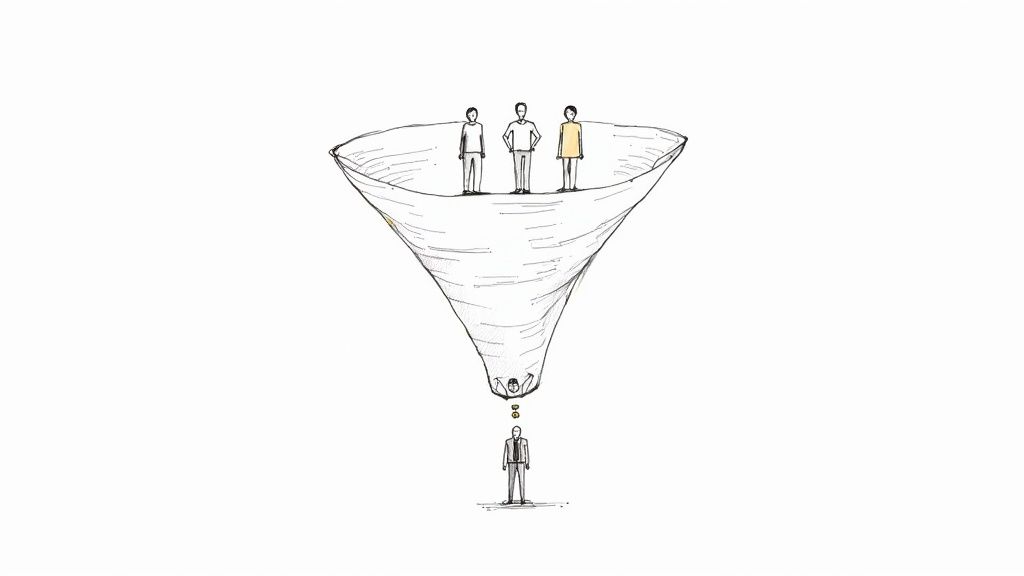
This decision tree gives you a simple mental model.

The flowchart drives home a critical point: even if your process feels fair, an outcome that whacks one group harder than another means you’ve probably got a problem.
But Here's The Catch
The Four-Fifths Rule is just a guideline. It's a blunt instrument, not a scalpel. If you're hiring for one or two roles and only have a handful of applicants, the numbers can get wacky fast. A single hire can flip your results and set off a false alarm.
The rule is a great first-pass check, but it crumbles with small sample sizes. Failing it doesn't mean you're guilty, and passing it doesn't mean you're in the clear.
This is where you might need more sophisticated stats. But for most of us, mastering the 80% Rule is the perfect place to start. It’s one of the essential recruitment KPIs you should be tracking if you're serious about building a fair and defensible hiring system.
Why This Is More Than Just a Legal Headache
If you think adverse impact is a problem for Fortune 500s with entire floors of lawyers, it’s time for a reality check. Getting this wrong can absolutely cripple a growing business. Ignoring your hiring data is like playing poker against a casino—the house always wins.
This isn’t some abstract, far-off risk. The consequences are real, and they are expensive.
Just look back at 2007. Federal agencies and courts dealt with over 67,500 discrimination charges under Title VII of the Civil Rights Act alone. Add another 19,103 age discrimination charges on top of that. The final bill? A cool $232.3 million for the Title VII cases and another $66.8 million for age discrimination. That’s a lot of companies who thought they were fine.
The Real Cost of Ignoring the Numbers
Those aren't just stats; they're thousands of companies that took a huge financial hit and suffered lasting damage to their brand. Ignoring adverse impact is like driving with your eyes closed. You might get away with it for a block or two, but eventually, you’re going to hit something very, very solid.
The rule of the road here is Title VII of the Civil Rights Act, which applies to any business with 15 or more employees. This isn't an enterprise-level problem; it's a standard cost of doing business.
And this goes way beyond just avoiding a lawsuit. This is about building a hiring process that's solid, fair, and defensible. Proactive monitoring isn't a "nice-to-have" anymore; it’s a core function for any company that wants to hire smart. Neglecting the data is a direct path to liability.
The legal landscape is a tangled mess, and keeping up can feel like a full-time job. Beyond just learning definitions, smart teams are using specialized tools. Platforms like LegesGPT can help you navigate the compliance maze, turning what used to be a reactive panic into a proactive strategy.
Once you get the financial and legal risks, it changes your whole perspective. Adverse impact stops being an abstract HR term and becomes what it is: a critical business metric.
Where Bias Hides in Your Hiring Process

We've talked theory. Let's get our hands dirty. Where does this problem actually live? The honest answer? Everywhere. Adverse impact loves to hide in plain sight, disguised as "standard procedure" or "our rigorous process."
You have to develop a nose for this stuff, because these issues almost never announce themselves. They’re buried in the day-to-day decisions you and your team make without a second thought.
The Gut-Feel Interview
This is Public Enemy No. 1. It’s that unstructured "let's just have a chat" interview where the hiring manager walks out and says, "I just have a really good feeling about them!" Translation: "They remind me of a younger, less-tired version of myself."
This approach practically rolls out the red carpet for bias. Without standard questions and a scoring rubric, interviewers fall back on what’s comfortable. It's no surprise when the people who pass the "vibe check" just happen to have similar backgrounds, hobbies, and senses of humor as the interviewer.
This isn't a hiring strategy; it's a cloning strategy. If you want to go deeper, we've broken down how to sidestep the different kinds of unconscious bias in recruitment.
Weaponized "Requirements"
Another favorite hiding spot is your job description. I’m talking about the "must-haves" that are really "nice-to-haves" or, even better, "completely-irrelevant-to-the-job-haves."
- The Pointless Physical Test: Requiring a physical ability test for a desk job where the heaviest lifting is a lukewarm cup of coffee.
- The "Harmless" Skills Test: Using a cognitive assessment that hasn't been validated for the role and ends up being a filter for a specific demographic.
- The Degree Obsession: Demanding a bachelor's degree for a role that could be done better by someone with five years of real-world experience and a certificate from the school of hard knocks.
If you can't draw a straight, defensible line from the requirement to success in the job, you're not being rigorous—you're just creating a hurdle. And that hurdle is where lawsuits are born.
The Double-Edged Sword of Tech
And don't think technology is a magic wand. It can scale your biases just as easily as it can solve them. An AI resume scanner trained on your biased historical hiring data will just get very, very good at replicating your past mistakes. Some video analysis tools have even been caught misinterpreting facial expressions based on cultural norms.
To get a handle on this, teams need to understand new rules like how to comply with Colorado's AI hiring rules. The key isn't to ditch tech, but to be brutally critical of it. Blindly trusting an algorithm is just as dangerous as blindly trusting your gut.
Building a Fairer and Defensible Hiring Process

So, you’ve run the numbers. The 4/5ths Rule is flashing a big, angry warning light on your dashboard. Your first instinct might be to panic.
Don't. Panicking isn’t a strategy. This is where we stop admiring the problem and start fixing it.
Our goal here isn't just to be "fair"—it's to build a process that is both fair and legally defensible. The two go hand in hand. You need a system that not only picks the best people but can also stand up in court if it's ever challenged. Think of it as building a fortress, not a picket fence.
First Things First: Validate Everything
Before you do anything else, you have to tackle the most critical step: validating your selection criteria. This is the bedrock of a defensible hiring process. You have to prove, with data, that every single requirement is directly tied to success on the job.
Are you positive that Ivy League degree is a must-have for writing good code? Can you actually prove that your personality test predicts better sales numbers? If you can’t, you’ve just found your weakest link.
To do this right, you need to run validation studies. It’s less scary than it sounds. It means:
- Defining Success: Figure out what high performance actually looks like in the role, using objective metrics.
- Linking Criteria to Success: Draw a direct, evidence-based line from each of your hiring criteria (a test score, a skill, an interview answer) to those performance metrics.
- Documenting Everything: Keep a meticulous record of this process. If you’re ever questioned, this documentation is your shield.
Structure Is Your Best Friend
Once your criteria are solid, look at the process. The biggest enemy of fair hiring is inconsistency. The antidote is radical structure.
This is where a tool like ours—toot, toot!—comes in. By using structured, asynchronous interviews, you level the playing field. Every candidate gets the exact same questions, delivered in the exact same way. There's no room for small talk to veer into biased territory or for one interviewer to ask softballs while another plays hardball.
This screenshot shows how you can build consistency right into your workflow.
What you’re seeing is a standardized scorecard. This is how you finally kill "gut feel" and replace it with data.
By forcing reviewers to score candidates on the same job-relevant criteria, you make the decision-making process transparent and accountable. You're not just hiring; you're creating an audit trail.
The final piece is training. You can build the most beautiful process in the world, but if your hiring managers don't know how to use it, it's worthless. They need to be trained on the scorecards, what a good answer looks like, and—most importantly—how to recognize and park their own biases at the door.
Frequently Asked Questions About Adverse Impact
Let's get to the questions you're probably yelling at your screen right now. These are the real-world concerns that keep people up at night. Let's skip the corporate jargon and get straight to the point.
Does Failing the Four-Fifths Rule Mean I'm Guilty of Discrimination?
No. Full stop. This is the biggest myth out there.
Think of the 4/5ths Rule as a smoke detector. When it goes off, it doesn't mean your house is burning down. It means there's smoke, and you need to go figure out if you burned the toast or if the wiring is on fire. It’s a signal, not a verdict.
Failing the test just establishes a prima facie case—a fancy legal term that means the ball is now in your court. The burden shifts to you, the employer, to show that your hiring practice is actually job-related and necessary. It's the start of the conversation, not the end of it.
The 4/5ths Rule isn't asking, "Are you guilty?" It's asking, "Can you show your work?"
Do Small Companies Really Need to Worry About This?
Yes. I know, you were hoping for a different answer.
The federal regulations—the Uniform Guidelines—apply to any employer with 15 or more employees. You're not too small to get sued. If you're past the "two founders in a garage" phase, you're on the field.
But here’s the real reason to care: risk. A massive corporation can probably absorb a discrimination lawsuit. It'll hurt, but they'll survive. For a small or medium-sized business, that same lawsuit can be an extinction-level event. It is infinitely cheaper to build a fair process now than to hire a team of lawyers to clean up a mess later.
How Can Asynchronous Interviews Help Reduce Adverse Impact?
This is where we get to be proactive instead of reactive. Asynchronous interviews are a powerful tool because they attack the number one source of bias: inconsistency.
When every interview is a free-for-all "chat," bias has a playground. Structured, asynchronous interviews shut it down.
- Enforced Structure: Every candidate gets the exact same questions, in the same order, with the same time to answer. It creates a sterile, level playing field where bias can't thrive in the conversational detours.
- Scorecard-Based Evaluation: This format forces your team to evaluate candidates against a pre-set, standardized scorecard. You’re not judging "a good vibe"; you're scoring specific, job-related skills.
- A Perfect Audit Trail: You have a complete, reviewable record of the entire screening process. If a decision is ever questioned, you don't have to rely on someone's hazy memory of a conversation from six weeks ago. You have the tape. You can show your work.
It helps turn hiring from a subjective art into an objective, data-driven science.
What’s the Difference Between Adverse Impact and Disparate Treatment?
This is a crucial legal distinction, but it's actually simple. It all boils down to one word: intent.
Disparate Treatment is the "smoking gun." It's intentional discrimination. It's a manager saying, "We don't hire people over 50," or deliberately tossing out resumes from a certain zip code. The motive itself is the problem.
Adverse Impact, on the other hand, is completely unintentional. It’s what happens when a perfectly neutral, well-meaning policy has the unintended consequence of hurting a protected group. With adverse impact, your intentions are irrelevant. The outcome is all that matters.
At Async Interview, we believe building a fair hiring process is just the smartest way to build a great team. Our platform gives you the structure and data to make consistent, defensible, and better hiring decisions. See how Async Interview can help you hire better and faster.