Let's get real. You’re drowning in candidate videos, your team’s notes are a pile of conflicting opinions, and "collaborative hiring" feels more like a cage match. It's not your fault. The old way—endlessly rewatching footage and trying to decipher scribbled notes—is a colossal waste of time. It’s slow, riddled with bias, and just doesn't scale.
Your Hiring Process Is Broken, Not Your Team
I’ve been there. You spend weeks sourcing fantastic candidates, only to lose them in the black hole between the first interview and the final decision. Why? Because your team is buried under the administrative weight of just remembering who said what.
Hope you enjoy spending your afternoons fact-checking resumes and rewatching interviews—because that’s now your full-time job.
This isn’t a people problem; it’s a process problem. The tools you’re using (or, more likely, not using) are forcing you to make high-stakes decisions based on foggy memories and half-baked notes.
The Real Cost of Doing Nothing
The hidden costs of a manual review process are brutal. It’s not just about the hours your team burns re-watching videos. It’s about:
- Top candidates slipping away: While your team is trying to get on the same page, your number one choice is busy accepting an offer from a competitor who moved faster.
- Burnout and frustration: Your best interviewers are tired of repeating themselves in endless debriefs. They feel like their thoughtful feedback just vanishes into thin air.
- Bias creeping in: When you’re forced to rely on "gut feel" instead of hard evidence, you're opening the door wide for unconscious bias. The loudest voice in the room wins, not the best argument.
Often, this broken process starts even before the first interview, with candidates struggling to beat the bots just to get a foot in the door. The whole system can feel designed for friction. We get into this early stage in our guide explaining what pre-screening is all about.
The painful truth is that without a single source of truth for candidate interviews, your "collaborative hiring" is just organized chaos. You're not making data-driven decisions; you're just comparing notes on who had the best gut feeling.
This is exactly where interview transcription software changes the game. It’s not just another "nice-to-have" tool. It's a fundamental shift that fixes the core problem from the inside out. Forget mortgaging the office ping-pong table for another recruiter; let's fix the broken workflow first.
So, you’ve decided to get your interviews transcribed. Smart move. Now you’re at a crossroads: AI-powered tool or traditional human service? This isn’t just a technical choice; it’s a strategic decision that hits your budget, your hiring speed, and your team’s workflow.
Anyone trying to sell you a "one-size-fits-all" solution doesn't get the realities of modern recruiting. I've used both, and the right answer always comes down to the specific hiring challenges you're trying to solve.
The Human Touch: When You Need a Real Person
Remember the classic method? You send an audio file to a service and get a near-perfect transcript back in a day or two. That’s human transcription. You pay a premium, often by the minute, for a real person to decipher every "um," "ah," and piece of niche industry jargon.
The biggest upside here is nuance. A human can usually distinguish between speakers talking over each other, understand a sarcastic comment, and correctly spell an obscure programming language.
But the downsides are huge: cost and speed. It’s like taking a taxi for every trip—great for a one-off journey, but the costs add up fast. If you're dealing with high-volume hiring, the expense becomes unmanageable. The 24-48 hour turnaround can also feel like an eternity when your top candidate is weighing multiple offers.
The Rise of AI: Automated Transcription Software
Enter AI transcription, the powerful newcomer promising near-instant results at a fraction of the cost. The global AI transcription market, which powers today's best interview transcription software, grew to an impressive $4.5 billion in 2024. This is directly linked to the explosion of asynchronous video interviews, where AI turns hours of footage into searchable text in minutes. For a deep dive, you can explore the latest trends in interview transcription and their impact.
Just a few years ago, using AI for a complex technical interview was laughable. The results were unusable. Today, the leading AI platforms can hit up to 99% accuracy, fundamentally changing how hiring teams assess talent.
The most obvious benefits are speed and predictable cost. You get a time-stamped, searchable transcript almost instantly for a flat fee. For screening hundreds of candidates, AI is really the only game in town.
Look, AI isn’t flawless. It can stumble with thick accents, get confused by crosstalk, and misinterpret specialized terms. But for most hiring, a 95% accurate transcript that’s instant and searchable is far more valuable than a 99% accurate one that arrives tomorrow at ten times the cost.
The true value of AI transcription goes beyond just converting speech to text. It’s what you can do with that text afterward. Modern platforms, including what we’ve built into Async Interview (toot, toot!), integrate transcription into a complete hiring workflow. It's less about getting a perfect script and more about creating a single, collaborative source of truth. This approach is a core part of the best AI interview tools available today.
AI vs. Human: A Pragmatic Comparison for Recruiters
To cut through the noise, here's how AI and human services stack up on the metrics that actually matter for hiring.
| Evaluation Criteria | AI Transcription Software | Human Transcription Service | The Founder's Verdict |
|---|---|---|---|
| Speed | Nearly Instantaneous: Transcripts are ready in minutes. | Slow: Turnaround is typically 24-48 hours. | For fast-paced hiring, AI is the clear winner. Speed is a competitive edge. |
| Cost | Low & Predictable: Often a flat monthly fee or low per-minute rate. | High & Variable: Priced per audio minute, so costs can escalate quickly. | AI offers incredible value, making transcription scalable even for small teams. |
| Accuracy | Very High (85-99%): Excellent for clear audio; may struggle with accents or jargon. | Highest (99%+): Humans can interpret nuance, context, and poor audio. | Human accuracy is top-tier, but AI is more than good enough for most recruiting needs. |
| Scalability | Unlimited: Transcribe hundreds of interviews without a bottleneck. | Limited: Scaling up means higher costs and potentially longer delays. | AI is built for volume. Human services are for a handful of critical interviews. |
| Integration | Seamless: Often built directly into hiring platforms for a unified workflow. | Manual: Requires downloading and uploading files, creating extra steps. | Integrated AI tools save time and keep all candidate data in one central place. |
Ultimately, it depends on your context. While human services offer unmatched accuracy for specific, high-stakes situations, AI-powered software provides the speed, scale, and cost-efficiency modern recruiting demands.
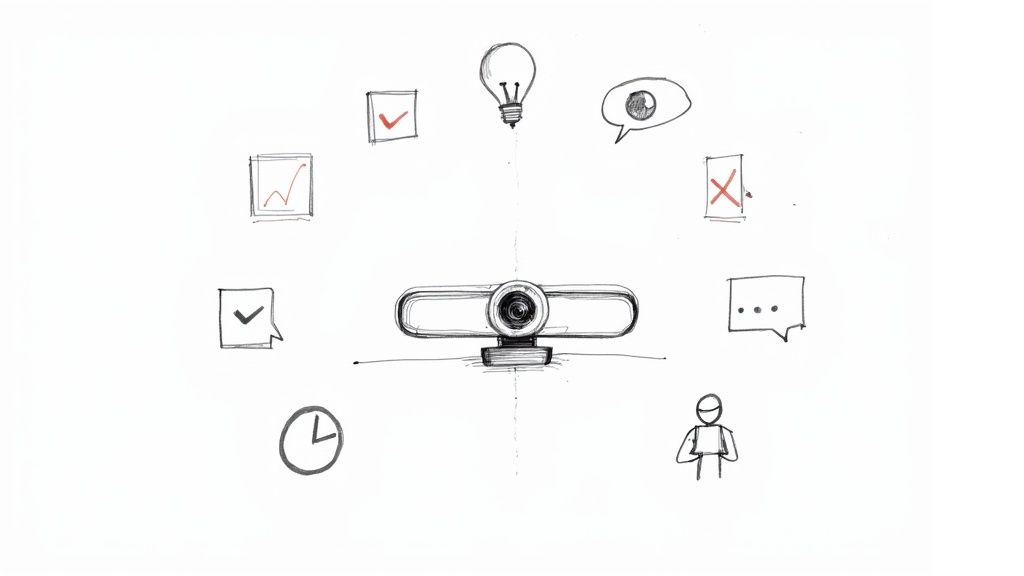
To help you decide, this decision tree can guide you through the process based on your team's specific needs.

The key takeaway? For routine, high-volume hiring, the speed and scalability of AI are unmatched. Save the human services for those crucial final-round interviews where every single word counts.
Must-Have Features vs. Shiny Distractions

Software vendors love to throw a tidal wave of features at you. Speaker identification! Sentiment analysis! AI-powered summaries! It’s easy to get hypnotized during a demo and sign up for a tool loaded with shiny objects that bring zero actual value.
I’ve sat through enough sales pitches to know the script. They pull up a dashboard that looks like a spaceship cockpit, promising it will magically surface your perfect hire. In reality? Most of it is noise.
So let's cut the crap. Here’s a practical guide to telling the difference between features that genuinely move the needle and those that just look pretty in a sales deck.
The Non-Negotiable Core Features
If the interview transcription software you're looking at can't nail these fundamentals, just walk away. It doesn’t matter how slick the other bells and whistles are; a tool with a weak foundation is useless.
- High Accuracy for Technical Jargon: Don't let them get away with just quoting an overall accuracy percentage. Test it with your own tricky interviews—the ones packed with engineering terms, financial acronyms, or candidates with thick accents. If the AI botches your core terminology, the transcript is worthless. Look for tools that let you build a custom vocabulary.
- Reliable Speaker Identification: This sounds basic, but you’d be amazed how many platforms get it wrong. A transcript that can’t clearly tell you who said what is just a confusing wall of text. It has to be dead simple to see the back-and-forth between your interviewer and the candidate.
- Time-Stamped, Clickable Text: Honestly, this is the whole point. The transcript shouldn't be a static Word doc; it has to be an interactive map of the conversation. You need to be able to click any sentence and immediately jump to that precise moment in the video. Anything less is a design failure.
It helps to see how other industries solve this. The best podcast transcription tools, for example, have perfected clean speaker labels and accurate timestamping because their users demand it for editing. Your hiring process deserves that same clarity.
The "Shiny Object" Features to Scrutinize
Now for the fun part—the features that sound incredible but often fall flat. I'm not saying they're always useless, but approach them with a healthy dose of skepticism until you see real proof of their value.
The "Magic" of Sentiment Analysis
The sales pitch is tempting: an AI that tells you if a candidate was positive, negative, or neutral. The problem is that these algorithms are notoriously bad at grasping context, sarcasm, and cultural nuance.
A candidate passionately describing a tough project they conquered might get flagged as "negative," while someone giving bland, people-pleasing answers gets a "positive" score. It’s a shortcut to biased, lazy decision-making. Don't fall for it.
Overly-Automated AI Summaries
An AI-generated summary can be a decent starting point, but it should never be the final word. These summaries frequently miss the crucial subtleties. They can tell you what a candidate said, but not how they said it.
Relying on them completely is like asking a robot for its "gut feeling." It’s a surefire way to miss the very cues that experienced interviewers are paid to pick up on.
The Real Game-Changers Built for Hiring
This is where we’ve focused our efforts. After years in the recruiting trenches, we've learned that the most valuable features aren't the flashiest. They're the ones designed specifically for a hiring team’s day-to-day workflow.
Here’s what really turns a simple transcript into a decision-making powerhouse:
- Collaborative, Time-Stamped Comments: This is essential. Your hiring manager needs to be able to highlight an answer in the transcript, tag a colleague, and ask, "What are your thoughts on this?"—all without leaving the platform.
- Direct ATS Integration: Do you enjoy spending your afternoons copying and pasting notes? I didn't think so. You need a tool that sends structured feedback straight into your Applicant Tracking System (ATS). It eliminates that mind-numbing admin work and keeps all your data in one place.
- Searchability Across All Interviews: Being able to search for "Python" within a single transcript is table stakes. A truly powerful tool lets you search "Python" across all your candidates and instantly compare their answers side-by-side.
At the end of the day, the best interview transcription software isn’t about flashy AI tricks. It’s about smart, practical features that make your team’s collaboration faster, easier, and more informed.
How to Properly Evaluate Interview Transcription Software
Reading a few online reviews is one thing. Battle-testing a tool is another. A free trial is useless if you don’t have a clear plan, so let’s build a playbook for putting any piece of interview transcription software through its paces in a real-world scenario.
First rule: forget their polished demo files. Those are designed to be flawless. You need to bring your own chaos. Throw your messiest, most challenging interview recordings at it—the ones with heavy accents, people talking over each other, and all the niche jargon that makes most AI tools stumble.
The Ultimate Accuracy Gauntlet
Your first and most important test is simple: accuracy. But I’m not talking about the fluffy "99% accurate" claim on their marketing site. You need to find out how accurate it is with your content. Here’s how.
- Grab Your Worst Recordings: Dig up a few of your most difficult video interviews. I mean the one with the soft-spoken engineer from halfway across the world, the interview where two managers kept talking over each other, and the one packed with so many acronyms it sounded like a secret code.
- Upload and Analyze: Feed these recordings into the software. Pay close attention to how it handles specific names, company terms, and technical keywords crucial for your roles.
- Check for Critical Errors: A few missed "ums" and "ahs" are no big deal. What matters is whether it turned "Kubernetes" into "Cooper's Netties." If the tool messes up the very keywords your team would search for, it's dead on arrival.
The goal isn't 100% perfection. It's about getting a transcript that is searchable and contextually correct enough to be useful. If you can't find key moments because the AI misheard the most important terms, you've just bought a very expensive, very useless text file.
There's a reason this market is taking off. Interview transcription is a key part of the AI meeting transcription segment, a market projected to hit a staggering $29.45 billion by 2034. This growth is fueled by demand for tools that handle real-world complexity. The best platforms can reach 99% accuracy, while the laggards often fall below 62% in messy scenarios. You can see what's driving this massive growth from recent AI transcription industry data.
Beyond the Transcript: Usability and Workflow
Once you've confirmed the accuracy is good enough, the real evaluation starts. Does this tool actually make your team’s life easier? Remember, a transcript by itself isn't a workflow.
Ask yourself these brutally honest questions:
- Is it actually intuitive? Can your least tech-savvy hiring manager log in and figure it out in less than five minutes? If the interface looks like an airplane cockpit, your team will never use it.
- How good is the collaboration? Can you highlight a great answer, @-mention a colleague, and start a discussion right there on the transcript? If you find yourself switching back to email or Slack to share feedback, the tool has failed.
- Does it play nice with your ATS? Check their integrations. Does it really sync with your Applicant Tracking System, or does it just spit out a clunky CSV file you have to import manually? A true integration means notes and feedback flow seamlessly.
Sniffing Out the True Cost and Security Risks
Finally, let's talk money and risk. The price on the website is rarely the true cost. You have to be a pragmatist and dig deeper before signing anything.
The $500 Hello:
Is the pricing truly all-inclusive? Or are there sneaky per-minute fees, overage charges, or extra costs for priority support? I've seen too many companies get lured in by a low monthly fee, only to be hit with a massive bill because they underestimated their usage.
Grill Them on Security:
This part is non-negotiable. Candidate data is sensitive. Ask them directly:
- Are you GDPR and CCPA compliant?
- Where is our data stored?
- Have you completed a SOC 2 Type II audit?
If the salesperson gets vague or tries to deflect, run. Any platform that doesn’t treat security as its top priority isn't worth the risk. Your company’s reputation is on the line.
Why an Integrated Platform Is the Only Smart Play

Let's be brutally honest. You can buy standalone interview transcription software. It’s tempting. You download your videos, upload them to a third-party service, and wait for the text to come back.
But then what? You're stuck copy-pasting highlights into your ATS, manually checking timestamps, and juggling file permissions. Suddenly, you’re not a recruiter anymore—you’re an administrator.
This approach is like putting a bandage on a gaping wound. It doesn't fix your workflow; it just adds another leaky pipe to an already overloaded process. You're creating more work, not less.
The Problem with Standalone Tools
The flaw with standalone transcription is that it treats the transcript as the final destination. It’s not. A transcript is just raw material. Its real value comes from what you do with it next.
When you use a separate tool, you create a disconnected, fragmented workflow. You get a text file, but it exists in a vacuum—completely isolated from your interview platform, your hiring team’s feedback, and your ATS. This friction wastes time and creates gaping holes where critical information falls through.
You’re essentially buying a car engine and congratulating yourself on owning a car. An engine is great, but it’s useless without the chassis, wheels, and steering to connect it to the road. A standalone transcript is an engine without a car.
This siloed approach is also a security nightmare. Every time you download a candidate's video or upload it to another platform, you're creating a new data security risk. In a world of GDPR and ever-tightening privacy regulations, that’s a liability you can’t afford.
The Power of an Integrated Ecosystem
This is where a platform like Async Interview changes the game. Here, transcription isn't an afterthought bolted on at the end. It’s woven directly into the fabric of your hiring process from the start.
This isn’t a minor convenience; it's a massive strategic advantage. It creates a single, unified ecosystem where the interview, the transcript, and the evaluation all live together, seamlessly.
Let's break down what that actually looks like:
- A Truly Seamless Workflow: A candidate completes their video interview. The platform automatically transcribes it. The transcript appears side-by-side with the video, instantly ready for your team. No downloads, no uploads, zero admin.
- Real Collaborative Power: Your hiring manager can highlight a sentence in the transcript, watch that exact video clip, and @-mention a colleague to ask for their take—all within the same window. Feedback becomes contextual and immediate.
- One Single Source of Truth: All candidate data—the video, transcript, scorecard, and comments—is consolidated in one secure place. No more hunting through email threads or Slack channels.
This integrated approach is quickly becoming the backbone of modern talent acquisition. It's why the business transcription market is set to more than double to $8.6 billion by 2033. For high-volume recruiters, intelligent transcription that’s part of the hiring platform boosts efficiency by up to 75%. You can explore the full business transcription market research for more on this growth.
Why Integration Is the Smarter Long-Term Play
Choosing an integrated platform isn’t just about saving a few administrative headaches. It’s about making a smarter, more strategic investment in your entire hiring operation. It plugs directly into the core principles of effective recruitment automation software.
An integrated system helps you:
- Hire Faster: By eliminating the administrative gaps, you dramatically shorten the time between interview and decision. While competitors are copy-pasting notes, your team is already making an offer.
- Reduce Bias: With a single, objective record of every interview, your team can evaluate candidates on the substance of their answers, not on foggy memories or gut feelings.
- Create a Killer Candidate Experience: A smooth, professional internal process translates into a better external experience. Candidates can feel when a company is organized and efficient.
Ultimately, the choice is yours. You can keep patching together a clunky system of disconnected tools, or you can adopt a single platform built from the ground up to solve the real-world challenges of hiring. It’s the difference between working harder and working smarter.
Frequently Asked Questions
Alright, let's get into the questions we hear all the time. These are the straight-shot answers, based on years of experience, for teams looking to move past the old, slow way of doing things.
Is AI Transcription Accurate Enough for Technical Interviews?
Let’s be honest: five years ago, the answer was a hard no. The transcripts were often a mess.
Today, the story is completely different. The best interview transcription software is surprisingly sharp, even with complex engineering terms. But here's what most people miss: chasing a perfect 100% accurate transcript is a waste of time. That’s not the real value.
The goal is a transcript that's 95-99% accurate, fully searchable, and perfectly synced to the video. This allows a manager to instantly jump to the exact 30-second clip where a candidate explains a tough concept, instead of re-watching a 45-minute video. For making a quick, confident decision, that's not just good enough—it's a massive improvement.
How Does Interview Transcription Software Handle Privacy and GDPR?
This is a huge one, and there's no room for compromise. If a vendor ever sounds vague when you bring up security, walk away.
Any company that treats security as an afterthought is a liability. Don’t let their poor planning become your problem.
Reputable platforms don’t just add security on; it’s a core part of their product. Look for clear GDPR compliance, end-to-end data encryption, and transparent data retention policies. Ask them directly: "Have you completed a SOC 2 audit?" If the answer isn't a confident "yes," consider it a major red flag.
This is where an integrated platform shines. When the entire process—from video submission to transcription to deletion—is handled in one secure system, you avoid the huge risk of downloading sensitive videos and uploading them to some unvetted, third-party tool.
Will My Team Actually Use This or Is It Just Another Tool to Learn?
That’s a fair and critical question. We’ve all seen expensive software licenses go unused because the tool was a pain to learn. The key to adoption isn't a long list of features; it's making the tool so natural to their workflow that not using it feels like a step backward.
If transcription is a separate, clunky step, your team will skip it. But if it’s built seamlessly into the platform they already use for reviewing candidates, it becomes both invisible and essential.
The user experience is everything. Can a recruiter scan a transcript, click a sentence to watch the matching clip, and leave a time-stamped comment for a colleague—all without leaving the page? If so, your team will adopt it. They’ll see it saves them time and headaches right from the start.
Can Transcription Software Really Help Reduce Hiring Bias?
Yes, it absolutely can—but it’s not magic. The software itself isn't the solution; it's a tool that helps you build and enforce a more objective process.
Unconscious bias creeps in when we rely on "gut feelings," foggy memories, or how much we liked someone’s personality. A transcript, on the other hand, gives you an objective record of what was actually said. It’s the source of truth for every interview.
When your team can evaluate candidates by comparing the substance of their answers side-by-side, you naturally focus more on skills and less on things like presentation style or personal affinity. It encourages a more disciplined, evidence-based discussion.
This isn't about replacing human judgment. It’s about giving your team better data to make sharper, fairer judgments. For any company serious about building a more equitable hiring process, it's a powerful tool.
Ready to stop wasting time and start making smarter hires? Async Interview integrates powerful AI transcription directly into your hiring workflow, turning hours of video into actionable insights.
Try Async Interview for free and see the difference for yourself.