A competency framework is your company’s playbook for what ‘great’ actually looks like. It's the difference between a job description begging for a "team player" and a system that defines the role by "proactively sharing critical information and providing constructive feedback that elevates the team’s output." One is a vague wish; the other is a measurable standard you can actually hire for.
Ditch the Guesswork. It’s Costing You a Fortune.
Let's be honest, "competency framework" sounds like something HR invented to justify its annual budget. It’s got that corporate, jargon-y ring to it that makes you want to check your phone. But stick with me, because ignoring this is one of the most expensive mistakes you can make.
For years, I hired on gut feel. I’d meet a candidate who "seemed sharp," had an impressive resume from a big-name company, and nailed the small talk. A few months later, I’d be tearing my hair out wondering why this brilliant person couldn’t execute, collaborate, or take ownership.
Sound familiar? That’s the pain of hiring on vibes and credentials alone. It's a gamble, and the house always wins.
The Real Problem with 'Gut-Feel' Hiring
The issue isn't that your gut is always wrong. It's that it’s inconsistent, biased, and impossible to scale. You might get lucky once or twice, but you can't build a team of A-players on luck. Hope is not a strategy.
A competency framework is the antidote to this chaos. It forces you to stop and define, in excruciating detail, what skills and behaviors actually drive success in a specific role at your company.
It’s not about finding someone who can do the job. It's about finding the person who will thrive doing it within your unique culture and workflow.
Think of it like a recipe. You wouldn't try to bake a cake by just throwing "some flour" and "a bit of sugar" into a bowl and hoping for the best. You use a precise recipe. A competency framework is that recipe for talent.
This isn’t just another corporate buzzword. It’s the foundation for building a team that actually delivers, reducing the costly churn of hiring mistakes, and finally getting everyone aligned on what "good" truly means. It turns abstract ideals into concrete, observable actions.
Alright, you're sold. The old "hire and hope" method just isn't cutting it. So, what actually goes into a competency framework? It’s not some complicated document only HR understands. It's a practical tool, and it really just comes down to three main pillars.
Get these three right, and you’re creating a blueprint for a top performer. Get them wrong, and you’re just inventing a fancier way to hire the same people who don't fit.
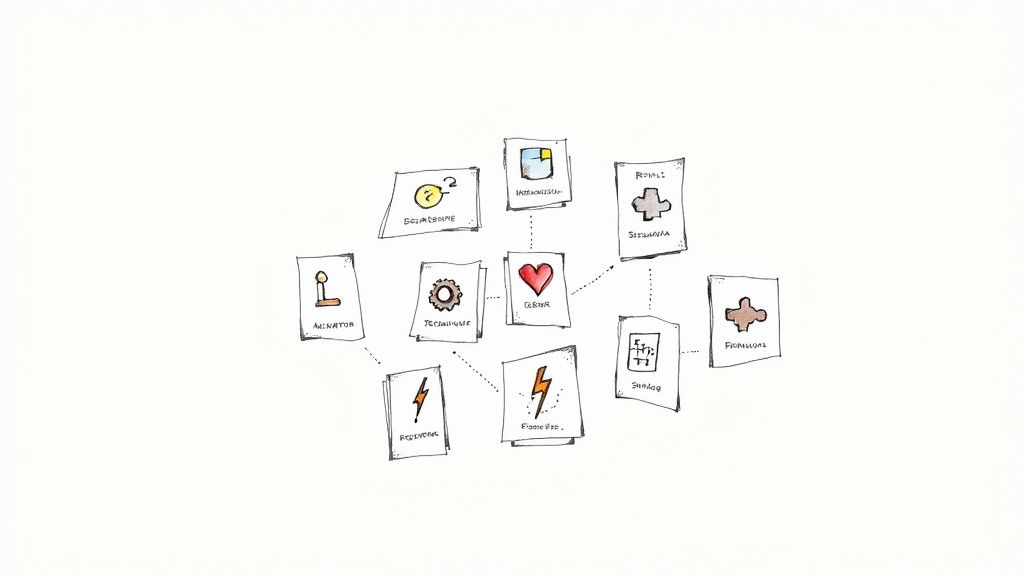
This diagram shows the shift away from vague wishes toward real, measurable standards.

The whole point is moving from wishful thinking to a clear yardstick. It turns hiring from a guessing game into a predictable process. Now, let’s break down the components.
Pillar 1: Core Competencies
Think of these as the must-haves for every single person at your company, from the CEO down to the newest intern. They are the non-negotiable behaviors that make up your company culture. This is your company's DNA, but actually written down.
Don't use a generic word like "Communication." That’s useless. Get specific. For example, we have a core competency called "Intellectual Honesty." This means we expect everyone to challenge ideas—even the CEO's—and admit when they're wrong without any drama.
Core competencies are your company's cultural immune system. They are the shared values that guide how your team works, makes decisions, and treats one another. It's what makes your company unique.
Here are a few real-world examples:
- Bias for Action: You see a problem and you don't wait for someone to tell you to fix it. Your default setting is doing, testing, and learning.
- Customer Obsession: You start with the customer's needs and work backward. You're proactive about finding their pain points instead of just waiting for complaints.
- Radical Candor: You're able to give and receive feedback that is both direct and kind. The goal is to help people improve, not just to be "nice."
Pillar 2: Functional Competencies
This is where you get into the nitty-gritty of the job. Functional competencies (or technical competencies) are the role-specific skills someone absolutely needs to do their job well. This answers the question, "Can they actually do the work?"
For a software engineer, this might be "Python Proficiency." But don’t just leave it at that. Define it. Is it writing simple scripts, or is it architecting a complex system of microservices? Be crystal clear.
For a content marketer, it might be "SEO Strategy," defined as the ability to do keyword research, create content that maps to a buyer's journey, and track organic traffic growth. It’s a lot more than just “knowing SEO.”
Pillar 3: Leadership Competencies
Wait—this isn't just for managers. Leadership competencies are for anyone who needs to influence, guide, or develop other people. That could be a senior developer mentoring a junior one, a project manager coordinating a team, or yes, a formal people manager.
These competencies define what it takes to inspire people, not just hand out tasks. They can be the most difficult to pin down, but they have the biggest impact on team happiness and retention.
- Developing Talent: Does this person actively coach their peers or direct reports? Do they delegate work in a way that helps others grow?
- Strategic Thinking: Can they connect what their team is doing day-to-day with the company’s bigger goals? Do they think ahead instead of just putting out today's fires?
- Driving Alignment: Are they skilled at getting a group of people with different opinions to agree on a single path forward and commit to it?
This move to formalize what "good" looks like isn't just a trend; it's a business necessity. A recent report showed that while 50% of organizations believe they will reach the highest stage of technology maturity by 2026, only 11% are actually there today. The race to define and build these competencies is on. You can learn more about how companies are measuring their maturity in the full report.
How to Build a Competency Framework (Without the 6-Month Headache)
Alright, this is where theory ends and work begins. The thought of "building a framework" probably conjures images of six-month consulting projects and a final document so dense it could be used as a doorstop.
Forget all that.
You don’t need a perfectly polished, 100-page opus. You need a "Version 1.0" that's immediately more useful than the "hire and hope" strategy you’re using now. Perfection is the enemy of progress. Let’s get our hands dirty.
Start with Your Stars
Who are the absolute best people in your organization? The ones you wish you could clone. The first step isn’t to brainstorm abstract qualities on a whiteboard; it’s to go talk to them.
This isn’t a formal interrogation. Just ask simple questions:
- What do you think makes someone successful in your role here?
- Think about a recent challenging project. What specific actions did you take to get it across the finish line?
- When you see a new hire struggling, what are they usually missing?
You’re not looking for vague answers like "I work hard." You’re digging for the specific, observable behaviors that separate the A-players from the B-players. This is a competency interview, and it’s gold.
Analyze the Role, Not the Resume
Once you've talked to your stars, analyze the actual job. I mean the real job, not the dusty job description that’s been copied and pasted for five years. What does success in the role actually require day-to-day?
Does a salesperson need to be a slick closer, or do they win by being a patient, consultative problem-solver for complex accounts? Does an engineer succeed by writing clever code alone, or by clearly documenting their work so others can build on it?
These distinctions are everything. They're the difference between hiring someone who looks good on paper and hiring someone who will actually get results in your environment.

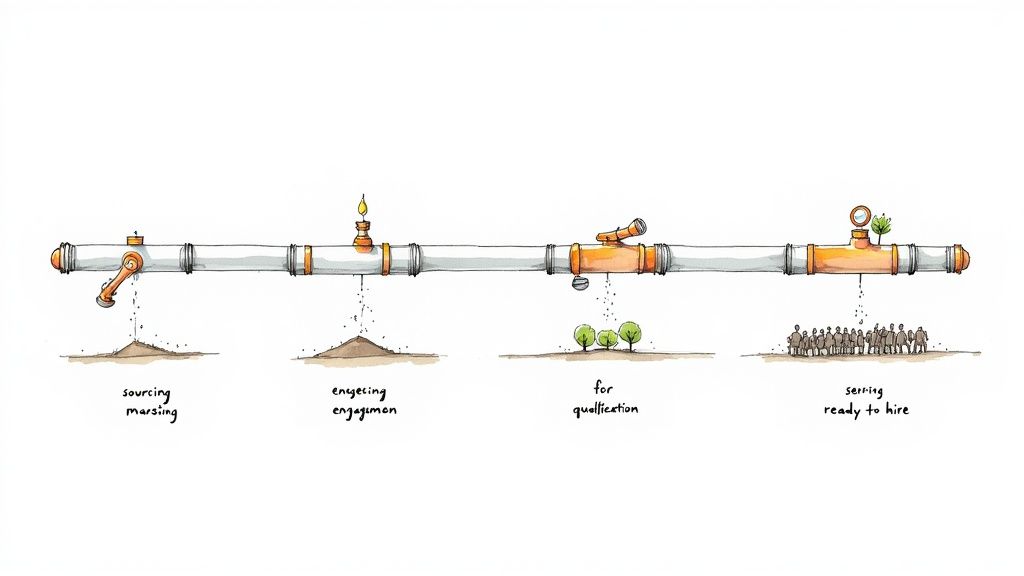
This diagram shows the path from talking to top performers to creating a usable structure. It's about extracting real-world behaviors and organizing them—far more valuable than just listing qualifications from a job ad.
Group and Define Your Findings
Now you have a pile of raw data—notes from your interviews and analysis of the role. The next step is to find the patterns and group them into a simple, usable structure. Look for recurring themes and bucket them into 3-5 core behaviors.
Don't overcomplicate it. Your Version 1.0 framework for a "Senior Product Manager" might look like this:
- Data-Informed Decision Making: Consistently uses product analytics and user feedback to justify feature priorities, rather than relying on gut instinct.
- Cross-Functional Influence: Proactively aligns engineering, marketing, and sales teams around a shared product vision, even without formal authority.
- Pragmatic Execution: Focuses on shipping valuable, iterative improvements quickly instead of getting stuck in analysis paralysis.
See? No fluff. Each point is a clear, observable behavior you can build a hiring process around. From here, you can develop powerful evaluation questions. To get started, you might be interested in our guide on creating an effective interview evaluation form.
This whole process isn't a static HR exercise. One global tech firm found that by mapping key competencies like collaboration and adaptability, they successfully upskilled 80% of their workforce and sped up project delivery by 25%. This shows that a competency framework isn't just theory—it directly impacts the bottom line.
Building your first competency framework isn't about creating a masterpiece. It's about taking a crucial step away from ambiguity and toward clarity. Your V1 won’t be perfect, but it will be infinitely better than a guess.
Putting Your Framework to Work: Weaponizing It for Hiring
So, you’ve wrestled your competencies into submission. High five. Now for the hard part: making it do something other than collect digital dust. A framework is useless if it’s not actively filtering your candidate pool.
This is where you weaponize it.
Think of your framework as the blueprint for your talent-finding machine. The machine itself? Asynchronous video interviews. This isn't just about saving time on scheduling—though, trust me, that alone is worth the price of admission. This is about systematically testing your competencies at scale.

It’s your chance to move beyond the resume and see candidates in action. You get to force them to show you, not just tell you.
From Competency to Killer Question
The magic lies in translating each competency into a killer interview question. Forget the softballs like, "Tell me about a time you worked on a team." They're useless. Everyone has a canned answer for that.
Instead, get specific. Turn your competencies into real-world scenarios.
-
Competency: "Pragmatic Execution"
- Bad Question: "Are you a good project manager?"
- Killer Question: "A feature is 80% complete, but the last 20% will take another month. A competitor just launched a similar, less-polished feature. You have two minutes: do you ship now or finish it? Explain your decision."
-
Competency: "Data-Informed Decision Making"
- Bad Question: "Do you use data?"
- Killer Question: "Here's a simplified dashboard showing user engagement dropping after our last release. You have 90 seconds to walk me through the first three questions you'd ask your team."
This is how you separate the talkers from the doers. You’re not just asking about their experience; you’re dropping them into a mini-simulation of the job and watching them react under pressure.
Build a Rubric and Stick to It
Asking the right questions is only half the battle. If your team is still evaluating candidates based on "a good feeling," you're right back where you started. You need a structured evaluation rubric tied directly to your competency framework.
A rubric isn't a bureaucratic checklist; it's an anti-bias machine. It forces every evaluator to use the exact same yardstick, judging the candidate's answer, not their charisma or alma mater.
For each question, your rubric should define what a "bad," "good," and "great" answer looks like, based on the behavioral indicators in your framework.
Example for "Pragmatic Execution" Question:
- Poor (1-2 points): Gives a generic answer ("It depends"), fails to make a decision, or focuses on blame.
- Good (3-4 points): Makes a clear choice and provides a logical reason, like balancing speed-to-market against quality.
- Great (5 points): Makes a clear choice, justifies it with business context (e.g., impact on revenue, user retention), and outlines immediate next steps and potential risks.
With a tool like Async Interview, this rubric is built right into the evaluation workflow. The team watches the video, scores the response, and leaves comments. No more post-interview "So, what did you think?" meetings where the loudest voice wins. The data speaks for itself. If you're looking for more ways to standardize your hiring, check out our guide on asynchronous video interviews.
The AI Assistant Who Never Sleeps
Now for the part that feels like cheating, but isn't. (Toot, toot!) Let’s talk about AI. Manually reviewing hundreds of video responses is a grind, even with a great rubric.
This is where AI becomes a recruiter's superpower. Modern platforms automatically transcribe every word a candidate says. This gives you a searchable, skimmable record of the interview.
Even better, AI can analyze those transcripts for key competency indicators—like the use of words related to ownership, data, or collaboration. It's not about replacing the human reviewer. It's about giving them an incredibly smart assistant that flags the must-see candidates first, saving them from wading through dozens of unqualified responses. This is what lets you scale a high-quality, competency-based process without having to mortgage the office ping-pong table.
Warning: Your Competency Framework Is Already Getting Stale
Here’s the deal: that shiny, new competency framework you’re so proud of? It’s already getting stale. The ground is constantly shifting, and a framework that doesn't change with it is a liability.
You wouldn’t navigate a new city with a ten-year-old map. Your industry is changing even faster. A competency framework can't be a one-and-done project. It has to be a living document that adapts as quickly as your business does.
The brutal truth is that skills have a shorter half-life than ever before. If you're building a team to solve last year's problems, you're preparing for a world that has already moved on.
The AI Tidal Wave Is Here
Nowhere is this shift more dramatic than with artificial intelligence. A few years ago, “AI skills” were a nice-to-have. Now, they're becoming a core requirement, and the demand is exploding.
A competency framework that doesn’t account for emerging skills like AI literacy is like a fortress built to defend against last century’s weapons. It looks impressive, but it’s functionally useless.
The gap between AI talent supply and demand is staggering. By 2026, demand for people with specialized AI skills is expected to outstrip supply by a ratio of 3.2 to 1. We've seen demand for AI Ethics Specialists and NLP/LLM Specialists skyrocket by 198% and 340%, respectively, just since 2023. This isn't just a trend; it's a talent crisis in the making.
In a market this tight, you can't just post a job and hope for the best. You need a system to spot potential, upskill your existing people, and hire for adaptability.
Keeping Your Framework Relevant
So, how do you prevent your framework from becoming a museum piece? You need a disciplined, ongoing feedback loop.
- Market Data Pulse Checks: Once a quarter, analyze job posts from your top competitors. What new skills are they asking for? What competencies keep popping up? This is your early warning system.
- Performance Review Insights: Your performance reviews are a goldmine. Are your top performers consistently showing off a skill that isn't in your framework? That’s your sign to add it. You can learn more about mining this data in our guide to performance management best practices.
- Strategic Shift Triggers: Anytime your company makes a big move—like entering a new market—it should automatically trigger a review of your competencies. What new skills and behaviors will it take to win?
To connect the dots between the skills you have and the skills you need, a formal skills gap analysis template is invaluable. It forces you to get honest about where your team stands today and where they need to be tomorrow.
Your competency framework is your North Star for talent. Keeping it updated ensures you’re always sailing toward future success, not off the edge of an old, outdated map.
Competency Frameworks: Your Questions, Answered
Alright, let's address some of the common questions that pop up. You’ve got the what and the why, but the "how" can still feel a bit fuzzy. Let's get practical.
Is Building a Competency Framework a Huge Project?
Only if you let it be. You don't need expensive consultants or an encyclopedic document to start.
For a growing company, you can get a "Version 1.0" up and running in a single afternoon.
- Start with just one mission-critical role.
- Grab your two top performers from that role for a 30-minute chat.
- Ask them: What behaviors or skills actually make you successful day-to-day?
- Listen for 3-4 recurring themes.
Boom. You have a basic framework for that position. It won't be perfect, but it will be infinitely better than hiring based on a "good vibe". Don't let the quest for perfection stop you from making a good start.
How Do We Measure If Our Framework Is Working?
The real test isn't how well you score candidates; it's the business results you see after they're hired. Measure its success with cold, hard metrics.
Don’t get lost tracking "competency scores." Track the business outcomes those competencies are supposed to drive. The data doesn't lie.
Here are the KPIs to watch:
- Faster Ramp-Up Time: Are new hires productive in 60 days instead of 90?
- Improved Retention: Is your 90-day retention rate for new hires rising?
- Shrinking Performance Gaps: Is the difference in output between your top and bottom performers getting smaller?
- More Efficient Hiring: Are your hiring managers spending less time on interviews that go nowhere?
If you notice that evaluation scores for a certain competency are all over the map, your definition is too vague. When scores are consistent and correlate with strong on-the-job performance, you've hit the mark.
Can This Really Reduce Hiring Bias?
Yes, and this is perhaps its most powerful benefit. Unstructured interviews are fertile ground for unconscious bias. It’s natural to feel a connection with people who share our background, but this is a terrible way to build a high-performing team.
A competency framework is a powerful counterbalance. It forces you to define what "great" looks like in objective, behavioral terms before you see a single resume. Every candidate is measured against the exact same standard.
When you ask every applicant the same structured questions and evaluate them with the same pre-defined rubric, you shift from comparing people to one another and start comparing their demonstrated abilities. This is how you uncover hidden talent and build a team based on merit, not just familiarity.
How Often Should We Update Our Framework?
Your competency framework should be a living document, not carved in stone.
Here’s a good rule of thumb:
- Functional Competencies: For roles in fast-changing fields like tech or AI, revisit them at least once a year.
- Core Competencies: Your company-wide values are more stable. A check-in every 18-24 months is usually fine.
The best trigger for a review is a major strategic change. If you're launching a new product or entering a new market, it's time to ask: "What new skills and behaviors do we need to win now?" Your framework should be a compass pointing toward your future, not an anchor holding you in the past.
Ready to stop guessing and start building a team of proven performers? Async Interview gives you the tools to turn your competency framework into a powerful, bias-free hiring machine. Design killer questions, use structured rubrics, and let AI help you spot top talent faster. Ditch the scheduling chaos and endless screening calls. Find out how you can hire up to 10x faster by visiting https://asyncinterview.io.