Let's get right to it. Interview bias is the little voice in your head that swears you’re hiring on pure merit, but is secretly just searching for someone you’d want to grab a beer with.
It's that gut feeling that torpedoes a perfectly qualified candidate because their handshake felt a bit off or they didn't laugh at your joke. This is your brain's natural shortcut system going haywire in the one place it can cause the most damage: your hiring process. We’ve all been there. We've all made the mistake.
So, What Is Interview Bias, Really?
Think of your brain as a super-efficient pattern-matching machine. It’s fantastic at making snap judgments to keep you safe and help you navigate the world. The problem? That machine doesn't know when to switch off. To get a handle on interview bias, you first have to understand the bigger picture of cognitive bias and how these mental shortcuts shape our decisions.
When you're sitting across from a candidate, your brain is quietly running its own background check, scanning for signals it recognizes.
- Did they go to your alma mater? +10 points.
- Do they remind you of a former rockstar employee? +20 points.
- Did they stumble over an answer because they’re nervous? -50 points.
This isn't a merit-based evaluation; it's a social reflex. We're all wired to favor what feels familiar and comfortable over the unknown—even when the unknown candidate has the exact skills you need to scale. Let’s be blunt: the traditional, unstructured interview is practically designed to fail, favoring charisma over actual competence.
This Is a Bigger Problem Than You Think
This isn’t just about a few "bad apples" making a poor decision here and there. It’s a systemic issue baked into the way we hire.
One analysis found that a staggering 48% of HR managers openly admit their personal biases influence candidate selection, often unconsciously steering them toward people with similar backgrounds or appearances. These subjective judgments are constantly derailing what should be a merit-based decision.
You think you're looking for the best person for the job. But most of the time, you're just looking for the person who is most like you.
This is exactly why so many companies end up with homogenous teams where everyone thinks, talks, and acts the same. It might feel safe, but it's a known killer of innovation.
We dive much deeper into the different kinds of unconscious bias in recruitment in our other guides. The first step is admitting there's a problem. The second is actually doing something about it.
The Seven Sneakiest Types Of Interview Bias
Alright, let's pull back the curtain and meet the usual suspects. If you want to spot interview bias out in the wild, you have to know what you’re looking for. These aren't just some dusty academic theories; they're the invisible influencers in your interview room, whispering terrible advice right into your ear.
Let's unpack the most common culprits. You’ve probably seen them in action. You’ve probably even been guilty of a few yourself. No judgment—we're all human, and our brains are wired for shortcuts.
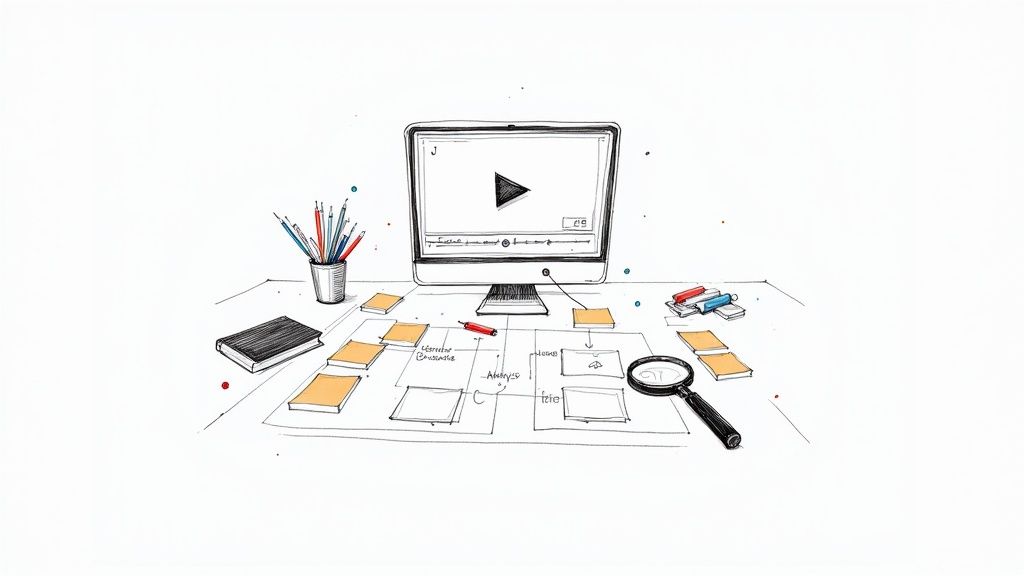
This handy map shows exactly how our gut feelings and whether we personally like someone can completely cloud our judgment, leading to some seriously unfair hiring decisions.

It’s a simple visual, but it nails the core problem: our brains are hardwired to connect the dots between "I like this person" and "this person is competent," even when there's zero actual evidence to back it up.
1. Affinity Bias
This one is the heavyweight champion of interview bias. Affinity bias is that "they're just like me!" feeling. It’s when you find yourself unconsciously favoring a candidate because they share your background, went to your alma mater, or happen to love the same obscure 90s band.
It feels like you're just building great rapport, but what you’re actually doing is building a team of clones.
2. Halo/Horns Effect
Ever meet a candidate with a magnetic personality and an impressive degree and just know they’d be a rockstar? That's the halo effect at work. One single, shiny positive trait casts a "halo" over everything else, making you ignore potential red flags in their actual skills. A firm handshake doesn't mean they can manage a complex project.
The nasty flip side is the horns effect. This is where one small negative—like a weak answer to the first question or showing up two minutes late—sours your entire perception of them. Suddenly, their years of relevant experience seem a lot less impressive. It’s a classic case of judging a book by one crumpled corner of its cover.
The halo effect is so dangerous because it feels good. You don't think you're being biased; you're just convinced you've spotted a "high-potential" candidate. But potential is a guess, and skills are data. Never confuse the two.
3. Confirmation Bias
This one is particularly insidious. Confirmation bias is your brain’s sneaky tendency to seek out information that proves what you already believe to be true. If you get a "bad vibe" in the first five minutes, you'll subconsciously spend the next forty-five hunting for evidence to justify that feeling.
- "Ah, they paused before answering that question. See? Not confident."
- "They mentioned a team project, but I bet they didn't do much of the actual work."
At that point, you're no longer conducting an interview. You're on a mission to prove yourself right, and you'll warp the conversation to do it.
4. Stereotyping And More
Beyond those top three, a few other biases are always lurking in the shadows, ready to sabotage a great hire.
- Stereotyping: This is the laziest one of all—making snap judgments based on a candidate's gender, race, age, or ethnicity. It’s not just illegal and unethical; it’s terrible for business.
- Contrast Effect: Your view of a candidate gets warped by the person you interviewed right before them. An average candidate can suddenly look like an all-star if they follow someone who was a complete disaster.
- Attribution Bias: You credit a candidate’s past successes to sheer luck but blame their failures on poor character or lack of skill. It’s the opposite of how we tend to judge ourselves, where our successes are earned and our failures are just bad luck.
- First Impression Bias: This is when you make a final call in the first few seconds of an interview and then stubbornly refuse to change your mind, no matter what they say or do next.
Recognizing these biases is the critical first step. The next, and most important, is building a hiring process that makes them almost completely irrelevant.
The High Cost Of A Gut Feeling Hire
We’ve all been there. You remember that “bad hire” from last quarter, right? The one who looked incredible on paper, aced the interview, and then… fizzled out within 90 days.
Let’s talk about the real price of that mistake. It’s a lot more than just a few months of wasted salary.
Interview bias isn't some abstract HR concept; it's a very real, very expensive problem. That "gut feeling" hire is a slow, quiet drain on your company's cash, talent, and momentum. Too many leaders write it off as the "cost of doing business."
It’s not. It’s the cost of a broken process.
Beyond The Wasted Salary
The most obvious hit is the money you can see. Recruitment fees, training resources, and the salary itself are all gone. But that’s just the tip of the iceberg. The real damage happens below the surface, quietly sinking productivity and morale.
Think about the ripple effect:
- Lost Productivity: Your team spent weeks, maybe even months, picking up the slack and cleaning up messes. Key projects stalled while your best people were pulled away from their actual jobs.
- Drained Morale: Nothing kills team spirit faster than watching a colleague coast while everyone else works twice as hard to cover for them. It breeds resentment and makes your A-players question their own commitment.
- Managerial Overhead: That manager’s calendar? It’s now filled with performance management plans and difficult conversations, all trying to fix a hiring mistake that shouldn't have happened in the first place.
The cost of a bad hire isn't just the money you spent on them. It's the opportunity cost of what your best people could have been doing instead of managing the fallout.
This is exactly where a simple hiring mistake escalates into a genuine business threat. Every biased hire is an unforced error that drags the entire team down with it.
The Hidden Costs You’re Ignoring
But the damage doesn't stop when the bad hire finally leaves. The consequences linger, impacting how the outside world—and future candidates—see your company.
It’s a tough reality, but candidates talk. Research from 2024-2025 found that a staggering 34% of candidates report experiencing bias in an interview. When that happens, 47% of them simply drop out of the process, turned off by the poor experience. You can explore more job interview statistics to see just how deep this problem runs.
Every person who walks away feeling they didn't get a fair shot is a potential negative Glassdoor review. They’re a warning to their professional network. And they’re often a top performer who will now go work for your competitor.
You’re not just losing one candidate; you’re poisoning the well for every future hire. And that’s before we even get to the risk of compliance issues and discrimination lawsuits.
Suddenly, that "gut feeling" hire looks a lot more expensive, doesn't it?
How To Actually Fix Your Biased Interview Process

Alright, we’ve talked enough about the problem. Just staring at the tangled mess of bias won't untangle it. It's time to get our hands dirty with real, actionable solutions that systematically dismantle bias in your hiring process.
Forget the fuzzy, feel-good advice like "just be more aware." Awareness is a starting point, not a strategy. We're talking about process-level changes that actually work because they force objectivity into a system that naturally defaults to subjectivity.
Here’s the practical playbook. No expensive consultants needed.
Stop Winging It and Start Structuring
The single most powerful change you can make is to kill the free-for-all "let's just have a chat" interview. You need to implement structured interviews. This simply means that every single candidate applying for the same role gets asked the exact same set of predetermined questions, in the same order.
No more veering off on random tangents about their favorite sports team or where they went to college. The goal is to collect a standardized set of data points so you can compare apples to apples, not apples to oranges.
If you’re not asking every candidate the same questions, you’re not conducting an interview. You’re just having a series of unrelated conversations and hoping a great hire magically emerges.
This one simple change shifts the entire evaluation. It moves from, "How much did I like them?" to "How well did they answer the questions that predict success on the job?" It's the difference between relying on a gut feeling and making a data-driven decision.
Create a Scorecard That Matters
Asking the same questions is only half the battle. You also need a consistent way to score the answers. This is where a well-designed interview scorecard, or rubric, comes into play. Before you even post the job, your hiring team needs to agree on what a "good," "average," and "poor" answer looks like for each specific question.
A good rubric forces interviewers to back up their ratings with actual evidence from the candidate’s response. To get started, you can even check out our complete guide on building an effective interview score card. It’s less about the final number and more about creating a solid framework for a high-quality, evidence-based discussion.
Here’s how it completely transforms your debrief meetings:
- Before: "I just got a much better vibe from Candidate A."
- After: "Candidate A scored higher on the 'Project Management' question. They provided a concrete example using the STAR method, while Candidate B's answer was purely theoretical and lacked specifics."
See the difference? It’s all about evidence over feelings.
| Feature | Traditional Interview (High Bias) | Structured Interview (Low Bias) |
|---|---|---|
| Questions | Random, conversational, differ for each candidate. | Predetermined, job-related, same for every candidate. |
| Evaluation | Based on "gut feeling," likability, and overall impression. | Based on pre-defined criteria using a scoring rubric. |
| Consistency | Low. Each interview is a unique, unrepeatable event. | High. Creates a standardized data set for fair comparison. |
| Legal Defensibility | Weak. Difficult to prove fairness or job-relevance. | Strong. Process is objective, consistent, and defensible. |
| Predictive of Performance | Low. Poor correlation with on-the-job success. | High. 2x more effective at predicting job performance. |
This table makes it pretty clear. The old way of doing things is a lottery; a structured approach is a strategy.
Anonymize the Top of Your Funnel
Bias can creep in at the earliest stages, and it's lethal. A name, a graduation year, or even a picture on a social profile can trigger all sorts of unconscious assumptions before you’ve even read a single bullet point about a person's skills. This is why anonymized screening is such a game-changer.
Simply strip out names, photos, and any other demographic data from resumes and applications before the hiring manager ever sees them. This forces the initial evaluation to be based on one thing and one thing only: the candidate's actual experience and qualifications.
It's also important to consider the role technology plays here. The use of tools like AI resume screening needs careful oversight to make sure you're not accidentally introducing new, automated forms of bias into the process.
Another powerful tool for this stage is the asynchronous video interview. By having all candidates answer the same pre-set questions on their own time, you standardize that initial screening. You get to eliminate the real-time biases that can pop up from a handshake or awkward small talk, allowing your team to focus purely on the quality and content of their answers.
The Asynchronous Advantage In Hiring

Alright, we’ve spent a lot of time breaking down the problem of interview bias. Now, let’s talk about a real solution. Full disclosure: this is personal for us.
We built Async Interview because we were tired of watching great candidates get passed over due to flawed, biased processes. We got frustrated seeing slick talkers beat out brilliant engineers simply because they were better at the live interview game. It felt like we were constantly hiring for charisma instead of actual competence.
So, we decided to change the rules of the game.
Hiring for Skill, Not for Schmooze
By their very nature, asynchronous video interviews strip away many of the real-time biases we've been discussing. Just think about it for a second. There’s no handshake to over-analyze, no awkward small talk to stumble through, and zero chance for a snap judgment in the first five seconds to color the whole conversation.
It’s just the candidate and the questions. That’s it.
This isn't about getting rid of the human connection. It's about making sure that when you do connect, it's with the people who are genuinely qualified for the role. By starting your process with a standardized, objective screen, you ensure your valuable time is spent with candidates who have already demonstrated their skills—not just their ability to “interview well.”
The goal isn't to hire people who are good at interviewing. The goal is to hire people who are good at the job. Asynchronous interviews force you to focus on the latter.
This approach completely flips the script. Instead of running on a gut feeling formed during a high-pressure 30-minute chat, you’re gathering consistent, reviewable data points from every single person who applies.
A System Built on Fairness
The real magic happens when you pair pre-set questions with collaborative evaluation. This is where you truly level the playing field and put a system in place to short-circuit interview bias.
Here’s how it works:
- Standardized Questions: Every candidate applying for the same role answers the exact same questions. This isn't just about being fair; it gives you a clean, apples-to-apples way to compare responses. You can learn more about crafting great questions in our guide to asynchronous video interviews.
- Collaborative Reviews: Your entire hiring team can watch, review, and score candidate responses using the same rubric. This puts an end to vague, "he said, she said" debriefs. Everything is on the record, which forces a discussion based on data, not just feelings.
- On-Demand Evaluation: Interviewers can watch responses on their own schedule, when they're actually focused and free from distractions. This helps eliminate the fatigue and contrast effect that often sneak in during back-to-back live interviews.
This isn't just a random list of features. It’s a completely different philosophy on hiring—one that’s built for fairness and effectiveness. For any founder or HR leader trying to scale a remote or high-growth team, it’s the modern answer to a problem that’s plagued hiring for decades, ensuring your next hire is based on proof, not just personality.
Frequently Asked Questions About Interview Bias
Alright, let's get right to it. We’ve covered the theory, seen the damage, and looked at the solutions. But I’m willing to bet you still have a few questions bouncing around. Let's tackle them head-on, no fluff.
Isn't Culture Fit Important For A Team?
Yes, but "culture fit" is almost always a Trojan horse for affinity bias. It’s the feel-good excuse we use to hire people who are just like us. Let’s be honest, how many times has "not a good culture fit" really meant "I wouldn't want to get a beer with them"?
It's time to stop looking for fit and start looking for value alignment.
First, pin down your company’s core values in concrete terms—things like "radical transparency," "customer obsession," or "bias toward action." Then, build behavioral questions that directly test whether a candidate lives and breathes those traits. This simple shift changes the entire conversation.
The question stops being, "Do I personally like this person?" and becomes, "Does this person demonstrate the principles that make our team successful?"
It's a subtle but critical difference. You get the team cohesion you're after without the discriminatory baggage you're not, and you stop hiring a bunch of clones.
Can Training Alone Eliminate Interview Bias?
Not a chance. Bias awareness training is a decent first step, but it’s absolutely not a silver bullet. Think of it this way: knowing that a donut is unhealthy doesn't magically stop you from craving one. Awareness doesn't override impulse.
Training is great for helping your team understand what interview bias is, but it won't stop their brains from taking those familiar shortcuts under pressure. People are still going to have gut feelings and first impressions.
The only way to truly fix the problem is to change the system itself. This means you must:
- Implement structured interviews so everyone is on a level playing field.
- Use scoring rubrics to force evidence-based decisions.
- Adopt tools like asynchronous interviews that make it structurally harder for bias to creep in.
Training raises awareness. A better process changes behavior. You need both, but don't ever fool yourself into thinking the first one is enough.
How Can I Convince Leadership To Invest In Bias Reduction Tools?
You have to speak their language: ROI and risk. Framing this as a "nice-to-have" HR initiative is a losing battle. You need to frame it as a core business decision that impacts the bottom line.
Forget the warm-and-fuzzies. Hit them with the cold, hard facts. Point out that the cost of a single bad hire is often 1.5 to 2 times their annual salary when you factor in lost productivity and wasted resources. Remind them of the looming risk of discrimination lawsuits, which are becoming more common in the age of AI hiring tools.
Then, pivot to the upside. Position tools that reduce bias not as a cost center, but as a competitive advantage. It's an investment in efficiency (hiring up to 10x faster), better decision-making, and securing the top-tier talent your competitors are fumbling. It’s about building a scalable, predictable engine for talent acquisition.
Ready to stop gambling on gut feelings and start building a hiring process that actually works? Async Interview gives you the tools to replace bias with data. Ditch the scheduling chaos and endless screening calls—try our platform for free and see how much faster you can find the right people when you focus on what really matters. Start your free trial today.