So, you need to hire engineers. You write a killer job description, hit "post," and wait for the magic to happen. Instead, you get buried under a mountain of resumes from people who claim they can build the next Google but can’t seem to solve a simple FizzBuzz. Sound familiar?
A technical assessment test is supposed to fix this. It’s the gatekeeper that separates the talkers from the doers. It’s the difference between saying you can code and actually shipping something that works. It’s supposed to give you cold, hard data on whether someone can do the job.
But let’s be real. Most companies get it dead wrong.
The Technical Hiring Headache Nobody Talks About
Let’s get real for a moment: your tech hiring process is probably a mess. You post a job for a Senior Engineer, and suddenly you’re drowning in resumes. Your afternoons are now dedicated to fact-checking credentials and running an endless gauntlet of technical screens. Hope you enjoy spending your afternoons fact-checking resumes and running technical interviews—because that’s now your full-time job.

Or, maybe you’ve gone the other route. You’re shelling out a small fortune to external recruiters who promise elite developers but deliver candidates who can’t tell a REST API from a recipe for toast. Turns out there’s more than one way to hire elite developers without mortgaging your office ping-pong table. Either way, you're stuck, and it's costing you.
The traditional "resume-first" approach is a coin toss. It relies on proxies for skill—like a prestigious university or a previous employer's brand name—instead of what actually matters: can this person solve the problems my team faces every day?
This isn’t just a rant; it's a diagnosis of a problem every hiring manager and founder in tech knows all too well. You're trying to find a needle in a haystack, but the haystack is on fire, and you’re paying for the privilege.
Why The Old Way Is Failing You
The old playbook just wasn't built for today's hiring reality. Relying solely on credentials might have worked when the talent pool was smaller and skill sets were more standardized. Now, it's a recipe for disaster.
Here’s a breakdown of the pain:
- It’s Incredibly Slow: Manually sifting through hundreds of applicants to build a shortlist can take weeks. By the time you find the good ones, they’ve likely accepted another offer. The best candidates are never on the market for long.
- It’s Riddled with Bias: Unconscious bias is a real and powerful force. We naturally gravitate toward resumes that look like our own, which means we penalize otherwise qualified candidates from non-traditional backgrounds.
- It’s a Poor Predictor of Success: A resume is a marketing document, plain and simple. It tells you nothing concrete about a candidate's problem-solving ability, their coding habits, or how they collaborate and handle feedback.
This outdated method traps you in a vicious cycle. You make a bad hire based on a polished resume, that person underperforms, and six months later you’re right back where you started—only now you’re down time, money, and team morale. Understanding the basics of what a pre-screening is can help you start to break this cycle.
There’s a much smarter path forward, one that uses a solid playbook and modern tools to find the right people, faster.
Alright, let's start at the beginning. Before you even think about writing a single line of a coding challenge, we need to talk strategy.
Jumping straight into designing a technical assessment without clear goals is a classic mistake. It's like building a new feature with no product spec. You'll definitely create something, but I can almost guarantee it won't be the right thing for the job.
So, take a step back and ask: what are we actually trying to accomplish here? The answer changes everything.
Are you hiring for a high-volume junior role where the main goal is just to filter out the noise? Or are you on the hunt for a rare principal engineer who will be making architectural decisions that could define the future of your company? A test that’s perfect for one of these scenarios is a total disaster for the other.
Don't Test for a "Good Developer"
This is one of the biggest traps I see teams fall into: creating a generic test for a vague "good developer" persona. Spoiler alert: there's no such thing. A brilliant backend engineer who lives and breathes database optimization might completely flub a front-end React task, and that tells you nothing about their actual value.
Instead of some generic checklist, your goals have to be welded to the specific competencies of the role you’re hiring for.
Stop asking, "Is this person a good coder?" and start asking, "Does this person have the specific skills we need to solve the problems our team is facing right now?" This single shift in perspective will revolutionize your technical hiring.
Think about the day-to-day reality of the job. What will this person spend 80% of their time doing? Your technical assessment needs to mirror that reality, not some abstract ideal of what a developer should know.
Map Your Test to Business Outcomes
Let's get pragmatic for a second. Your technical assessment isn't just an academic hurdle; it's a business tool. And like any tool, it needs to deliver a real return. The goals you set should be measurable and tied directly to what the business actually cares about.
For instance, are you trying to:
Reduce Time-to-Hire? If this is your main pain point, then the goal is a fast, efficient screen at the top of the funnel. A short, automated multiple-choice quiz or a simple coding challenge can quickly weed out the 70% of applicants who are clearly unqualified, saving your engineering team countless hours.
Improve New Hire Quality? Here, your goal is all about predictive accuracy. This calls for a much deeper assessment, like a small take-home project or a structured live-coding session that simulates real work. This is where you get to see a candidate’s problem-solving process in action, not just their final answer.
Boost Employee Retention? This is the long game. When you hire people who are a fantastic match for the role's actual demands from day one, they're far more likely to feel successful and stick around. In fact, well-designed technical assessments have been shown to slash employee turnover by as much as 39%. You can dig deeper into how structured tests predict long-term success in this insightful hiring tool research.
Pinpointing your primary goal makes it obvious which type of assessment you need to build.
Consider Your Company Context
Finally, your goals have to make sense for your company's stage and culture. What works for a massive, process-driven enterprise will absolutely suffocate a nimble startup.
Startup Scenario:
You're a 20-person team moving at a dizzying pace. You need a versatile engineer who can juggle multiple priorities and ship code without a lot of hand-holding.
- Your Goal: Assess for pragmatism, speed, and the ability to work with ambiguity.
- Your Test: A small, practical project that mimics a real feature request. You're testing for a "get it done" attitude, not theoretical perfection.
Enterprise Scenario:
You're a Fortune 500 company with entrenched processes and complex legacy systems. A new hire has to understand scale, security, and how to navigate a massive, intricate codebase.
- Your Goal: Assess for rigor, attention to detail, and a solid grasp of enterprise-level architecture.
- Your Test: A code review of a problematic module or a system design question focused on scalability and long-term maintenance.
Skipping this foundational step is exactly why so many technical hiring processes are broken. They end up frustrating great candidates with irrelevant puzzles while somehow letting mediocre ones slip through. Define your goals first, and you’ll already be miles ahead of the competition.
Choosing the Right Technical Assessment Test Format
So, you've nailed down your hiring goals and you know exactly why you need to test candidates. Now comes the critical part: deciding how you're going to do it. Turns out, there's more than one way to see if a developer actually has the chops, and picking the right assessment format is where your strategy meets reality.
This isn't about finding a single, magical "best" format. It's about matching the tool to the job, your specific role, and the kind of experience you want candidates to have. If you get this step wrong, you risk testing for all the wrong things—like how well someone handles pressure instead of how well they can actually code.
The Quick and Dirty Multiple-Choice Screen
First up, we have the classic multiple-choice question (MCQ) or short-answer quiz. Think of this format as the bouncer at a popular club. Its job is incredibly simple: quickly check IDs at the door and turn away anyone who clearly doesn't belong.
This is a fantastic tool for high-volume, top-of-funnel screening. When you're staring at 500 applications for a single junior role, you just don't have the bandwidth to review 500 individual coding projects. A quick 15-minute quiz on core language concepts can instantly filter out the 70-80% of applicants who, to be frank, just aren't qualified. It's fast, it’s scalable, and it’s cost-effective.
But there’s a major trade-off. It’s a blunt instrument. It's great for testing memorized knowledge, but it tells you very little about practical application. A brilliant engineer who has spent the last five years deep inside a specific framework might completely blank on the exact syntax for some obscure vanilla JS method.
Use MCQs as a filter, not a final verdict. They tell you who can't do the job, but they don't tell you who can. Relying on them too heavily is a recipe for false negatives.
Technical Assessment Format Showdown
Choosing the right format can feel overwhelming. Each one has its place, but using the wrong one at the wrong time can sink your hiring process. This table breaks down the most common formats to help you decide which tool is right for your specific need.
| Format | Best For | Pros | Cons |
|---|---|---|---|
| MCQ / Quiz | High-volume, top-of-funnel screening for junior roles. | Fast, scalable, cheap, and weeds out unqualified applicants early. | Tests knowledge, not application. Prone to false negatives. |
| Live Coding | Late-stage, collaborative sessions for senior roles. | Assesses real-time problem-solving, communication, and collaboration. | High-pressure and anxiety-inducing. Can test for nerves over skill. |
| Take-Home Project | Mid-to-late stage evaluation for mid-to-senior roles. | Best way to see "real world" coding style, quality, and habits. | Time-consuming for both candidates and reviewers. Can feel like "free work." |
| Async Video | Mid-funnel screening for a mix of roles. | Great balance of seeing code and communication skills without scheduling chaos. | Lacks real-time interaction and collaborative problem-solving. |
Ultimately, no single format is a silver bullet. The best strategies almost always involve a blend of these, tailored to the specific stage of your hiring funnel.
The High-Pressure Live Coding Challenge
Next, we have the live coding challenge—the one that gives most developers nightmares. It involves a shared screen, a ticking clock, and an interviewer watching their every move. The idea is to simulate pair programming and get a window into how a candidate thinks on their feet.
In theory, this sounds perfect. You get to see their thought process in real-time. But in practice? It often ends up being a test of performance anxiety more than coding competence. I’ve seen some truly brilliant developers completely freeze under that kind of pressure.
So, when does it actually make sense? I’ve found it’s most valuable late in the process, especially with senior engineers, when it's framed as a collaborative problem-solving session. Don’t just sit there and watch them code; work with them. It morphs from an interrogation into a test of communication and collaboration—skills that are non-negotiable for senior roles. For a junior developer? It’s usually just cruel.
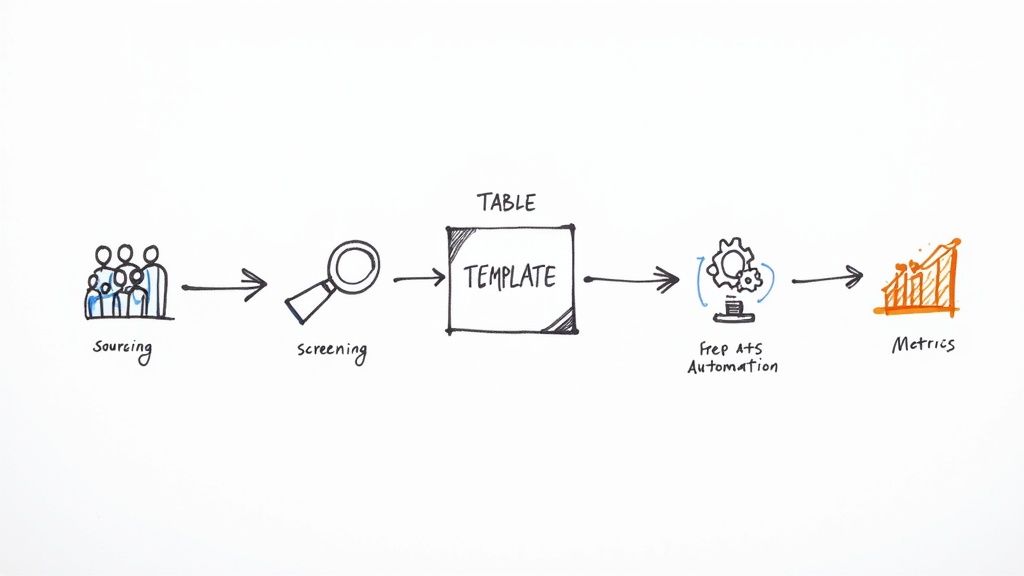
This infographic breaks down how your goals should influence your choice.

As you can see, the path diverges quickly depending on whether you're optimizing for volume screening or an in-depth evaluation of a senior candidate.
The "Real World" Take-Home Project
The take-home project is often hailed as the gold standard for technical assessments. You give the candidate a small, self-contained task—like "build this API endpoint" or "debug this broken React component"—and give them a few days to work on it. It's the closest you can possibly get to seeing what their actual work product looks like.
You get to see their coding style, their testing habits, and how they structure a project from the ground up. It’s fantastic for assessing practical, on-the-job skills.
The massive, glaring downside? Time. You are asking candidates for free work. Sending a 10-hour project to a junior developer who likely has a full-time job and a family is disrespectful and a surefire way to lose great people. For senior or lead roles where you’re making a six-figure bet, a well-defined 4-6 hour project can be reasonable. For everyone else, keep it short (1-3 hours max) or, even better, offer to pay them for their time.
The Blended Approach: The Smart Play
So, which format is best? None of them. And all of them.
The smartest and most effective strategy is a blended one that maps directly to your hiring funnel. You start with a wide net at the top and get progressively deeper and more hands-on as you narrow the field.
Early Stage (Top of Funnel): Start with a quick, automated MCQ or a very small coding exercise. The goal is simple: weed out the masses efficiently and respectfully.
Mid-Stage (Deeper Dive): This is the perfect spot for a short take-home project or an asynchronous video interview where candidates can explain their code. It gives you a great sense of their work and communication style without the nightmare of scheduling.
Final Stage (The Home Stretch): Reserve this stage for a collaborative, live session focused on higher-level skills like system design or refactoring an existing piece of code with one of your senior engineers.
This layered approach gives you multiple data points on each candidate, balancing your team's efficiency with the depth of your evaluation. It respects the candidate’s time while giving you the critical insights you need to make the right hire. While you're assessing hard skills, remember that a holistic view is best. Understanding other formats, like cognitive ability tests, can add another valuable layer to your evaluation process. In the end, the right technical assessment isn't just one test; it's a thoughtful and strategic process.
You've picked a format. Great. Now for the part where so many companies completely fumble the ball.
They either dust off a Computer Science final exam from 1998 or grab a senior engineer between sprints and ask them to throw together a “quick little test.” Both are truly terrible ideas.

Let’s be honest: designing a great technical assessment is an art form. It's about crafting a challenge that's tough but fair, and relevant without being esoteric. If your test still asks candidates to reverse a binary tree on a whiteboard, you’ve already failed. We aren't hiring theoretical computer scientists; we're hiring engineers to build and fix real-world stuff.
Your goal is to simulate a day on the job, not a day in a lecture hall.
Make It Mirror the Real Work
This sounds like a no-brainer, but you would be shocked at how often it's ignored. The absolute best technical test is a small, self-contained version of a task the new hire would actually tackle in their first few months.
Think less about abstract algorithms and more about the practical problems your team solves every day.
- For a Backend Engineer: Forget the brain teasers. Ask them to build a single, simple API endpoint that includes a couple of business logic rules.
- For a Frontend Developer: Give them a slightly broken React component. Their task? Debug it and then add one small new feature.
- For a DevOps Engineer: Provide a basic infrastructure-as-code file and ask them to add a new resource, explaining the security choices they made along the way.
This approach is brilliant for two reasons. First, it gives you a stunningly accurate signal of their real-world skills. Second, it gives the candidate a genuine preview of the job. It’s a two-way evaluation, after all.
The acid test for any assessment question is this: "Would an engineer on my team ever need to solve a problem like this?" If the answer is no, throw it out. It's just irrelevant noise that will frustrate your best candidates.
The Art of the Crystal-Clear Problem Description
I’ve seen tests with instructions so vague they were basically Rorschach blots. “Build a user management system.” What does that even mean? What are the requirements? The constraints? Don’t do this to people.
Your problem description is half the battle. A great one leaves zero room for ambiguity.
A good problem description includes:
- A Clear Goal: "Your task is to create a REST API endpoint that accepts a
POSTrequest to/ordersand saves the data." - Specific Requirements: "The payload will contain
productIdandquantity. You must include validation to ensurequantityis greater than zero." - The Definition of Done: "Your solution is complete when it passes all the provided unit tests. Bonus points if you write one new test case."
- A Stable Environment: Provide clean, ready-to-use boilerplate. Don't make them burn 45 minutes wrestling with Webpack configurations. That’s not what you’re testing.
Wasting a candidate’s time on setup is a classic rookie mistake. It shows a lack of respect for their time and muddies your results with irrelevant friction.
The Time Limit Tightrope Walk
So, how long should a test be? This is a delicate balance. You need it to be long enough for them to do thoughtful work, but short enough that it doesn't feel like you’re asking for a free project.
For any screening test—whether it's a short coding challenge or a small take-home—my hard-and-fast rule is that it should take no more than 2-3 hours of focused effort. Anything more for an unpaid initial screen is a huge overreach.
If you have a more involved project for a final-stage, high-stakes role, you should seriously consider paying the candidate for their time. It’s a powerful signal of respect and professionalism. Great candidates have options, and they’ll gravitate toward companies that treat them well from the very start. If you want more ways to stand out, check out our guide on how to improve the candidate experience.
That Pesky Cheating Question
Let’s talk about cheating. Yes, it happens. People will Google solutions or, even worse, have a friend do the test for them.
But turning your hiring process into a surveillance state with intrusive proctoring is a terrible response. It creates a hostile, untrusting environment right from the get-go.
The best way to combat cheating is simply to design tests that are harder to cheat on in the first place.
- Use Unique, Custom Problems: Stay away from the famous interview questions that have a million solutions posted online. Create a problem that’s specific to your company’s domain.
- Ask Them to Explain Their Work: The single most powerful tool against cheating is a follow-up. Ask them to record a short video explaining their code, the trade-offs they considered, and why they chose a particular approach. It’s easy to copy code; it's much, much harder to convincingly explain code you didn’t write. (Toot, toot! Yes, this is exactly what our platform, Async Interview, is built for.)
- Focus on Debugging and Refactoring: Give them a piece of existing, slightly broken code. These "brownfield" projects are far more realistic and much harder to find a canned answer for on Stack Overflow.
By designing better, more relevant tests, you not only get a clearer signal on a candidate's ability but also naturally reduce the incentive and opportunity for dishonesty. You end up testing for both skill and integrity at the same time.
Building Your Automated Tech Hiring Stack
A brilliantly designed technical assessment is a great start, but it’s pretty useless if it’s just a fancy document sitting on your desktop. It's like having a race car with no racetrack. The real magic happens when you operationalize your assessment and plug it into a smooth, automated workflow. This is where you graduate from just testing candidates to building a true tech hiring machine.
Let’s be honest: manually sending out tests, chasing candidates for submissions, and then begging your engineers for reviews is a special kind of hell. It's a soul-crushing admin vortex that kills momentum and lets great candidates slip away. The goal isn’t just to find talent; it’s to do it without losing your mind.
The answer is building an automated tech hiring stack—a set of tools that talk to each other, move data seamlessly, and turn your disjointed process into a well-oiled system.
Your ATS and Assessment Platform Must Be Best Friends
Your Applicant Tracking System (ATS) is your hiring command center. Your assessment platform is your quality control department. If they aren’t communicating, you’re creating double the work for yourself.
A proper integration means:
- Triggering tests automatically: When a candidate hits a certain stage in your ATS, the assessment gets sent out. No emails, no spreadsheets, no "Did you remember to send the test to Jane?"
- Centralizing results: The candidate’s score and their entire submission land directly back in their ATS profile. Your team gets one single place to see the whole story—resume, test results, and interview notes.
- Collaborative reviews in one spot: No more forwarding links or downloading zip files. Your hiring team gets notified and can review the submission right where they already work.
This isn’t some futuristic fantasy. This is table stakes for any team that wants to hire more than a couple of engineers a year without pulling their hair out. We know a thing or two about this, as our guide to recruitment automation software explains in detail.
The goal is to build a system so seamless that from the moment a candidate applies to the moment your team reviews their test, almost no human intervention is needed. This frees up your team to do what they're paid for: evaluating talent, not managing logistics.
Navigating the Exploding Assessment Platform Market
Choosing the right tools can feel overwhelming. The global market for coding tests and assessment platforms is exploding, projected to hit USD 7.37 billion by 2025 and keep growing at a dizzying pace. This surge shows just how many companies are waking up and realizing that the old way is broken. You can explore more data on this coding assessment market research.
With so many options, how do you cut through the noise? Don’t get blinded by a long list of features you’ll never use. Focus on what actually matters for building an automated stack.
As you build out your tech hiring stack, it's crucial to evaluate the best talent acquisition software platforms to find the one that fits your process, not the other way around. Look for a platform that plays nicely with others and prioritizes a clean, automated workflow. That’s the real secret to transforming your hiring process from a manual chore into a scalable engine for growth.
Why the Candidate Experience Matters Most
Here’s a hard truth many hiring managers miss: your technical assessment is not just a filter. It's a giant, flashing billboard for what it’s like to work at your company. A clunky, confusing, or disrespectful process doesn't just weed out the wrong people—it actively repels your top prospects. And you can bet they'll be talking about it on Glassdoor, LinkedIn, and their private Slack channels.

We get so wrapped up in perfecting the test itself that we forget there's a human being on the other end. This is precisely where the war for talent is won or lost. Every single touchpoint, from the first email to the final feedback (or lack thereof), shapes a developer's opinion of your entire brand.
The $500 Hello
I’ll never forget the story of a company that fired off a five-hour take-home project with a broken setup and zero instructions. After a dozen confused emails went into a black hole, one fed-up senior engineer simply sent the company an invoice for his wasted time. You do not want to be that company.
A positive candidate experience isn't about being "nice"; it's about being professional, respectful, and organized. Here’s how you get it right:
- Set Crystal-Clear Expectations: Tell them exactly what to expect, how long it will realistically take, and what you’re evaluating. Ambiguity is the enemy—it just creates anxiety and frustration.
- Be Responsive: A simple "Got it, thanks!" after they submit their work goes a long way. Don't leave people hanging for two weeks, wondering if their email even went through.
- Give Feedback. Always: This is non-negotiable. Even a templated "no" with a single, specific piece of constructive feedback is a thousand times better than ghosting someone.
Remember: The person taking your test today could be your star engineer next year, a future customer, or your most vocal critic online. How you treat them is entirely your choice.
Your Brand Is on the Line
A poor candidate experience comes with real business costs. Top developers talk to each other, and a reputation for a grueling or thoughtless hiring process will poison your talent pool faster than you can say, "We're hiring!"
The assessment services market is projected to explode to USD 29.54 billion by 2030 as more companies try to standardize their hiring. You can get the full rundown on these global assessment service market trends. This growth means engineers will face more tests than ever, and they'll have higher expectations. A thoughtful, candidate-first process is no longer a perk; it’s a critical competitive advantage.
Frequently Asked Questions
Alright, let's get into the nitty-gritty. These are the questions that pop up constantly when I'm talking with teams trying to dial in their technical assessment process. If you're wrestling with these, you're in good company.
How Do I Test for Senior Vs Junior Developer Skills
This is a big one, and it's where a lot of tests go wrong. For junior developers, you’re really just checking for a solid foundation. Do they get the core concepts? Can they produce clean, working code without too much hand-holding? Their test should be focused and constrained. You're testing for potential, not perfection.
With senior developers, you're hiring for judgment. The game changes completely. It's less about whether they know a specific syntax and more about how they think. The focus has to shift to architecture, system design, and making smart trade-offs.
Give them an open-ended problem like, "How would you design a notification system for a million users?" Or, even better, hand them a messy, real-world-ish codebase and ask them to refactor it, explaining their choices and critiquing the original design. A senior technical test should be a window into their wisdom.
Are Technical Assessment Tests Biased
They absolutely can be. It’s a huge, unintentional trap many well-meaning companies fall into. Bias slips in through culturally specific problem sets, unrealistic time limits that disadvantage neurodivergent candidates, or by subconsciously overvaluing someone who went to a "top" university.
The best defense against bias is a good system. Standardize everything with a crystal-clear rubric, have multiple people review submissions blind (no names or identifying info), and make sure the test is hyper-focused on the actual skills needed for the job. Anonymizing the results is such a simple, powerful way to let the best work speak for itself.
What Is the Best Way to Give Feedback to Candidates
First things first: always give feedback. Ghosting candidates after they’ve spent hours on your test is a surefire way to torch your employer brand. And trust me, people talk.
The key is to be constructive and tie your feedback directly to the scoring rubric you built. Instead of a generic, "Sorry, your code wasn't what we were looking for," you can offer something tangible. Try something like, "The solution worked, which was great to see, but we were looking for more comprehensive test coverage, especially around edge cases like X and Y."
Even a simple, automated email that pulls from your rubric scores can provide genuine value and shows you actually respected their time and effort.
Ready to build a hiring process that candidates don't dread—and that actually finds you the right people? Async Interview helps you create video assessments where developers can explain their code and walk you through their thought process. You get deep insights without all the scheduling chaos. It's time to stop the surveillance and start seeing how your candidates really think. We’re not saying we’re perfect. Just more accurate more often.