If you want to have any hope of reducing staff turnover, you first have to grasp its true, crippling cost. It's not just about recruiting fees. We’re talking a toxic cocktail of lost productivity, plummeting morale, and precious institutional knowledge walking right out the door.
And the only way to win this fight is to stop the bleeding at the source. That means fixing your hiring process before you even start thinking about retention perks.
The Hidden Costs of Your Revolving Door Problem

Let’s be brutally honest. That resignation email in your inbox feels like a punch to the gut. It’s not the polite "we wish you the best" sign-off; it's the sinking feeling that you have to start all over again. Again.
High turnover is a silent killer of your budget, team morale, and forward momentum. It’s a relentless cycle that quietly siphons away resources while you're busy trying to run the actual business.
This isn’t about shaming you with generic stats or suggesting you mortgage the office ping-pong table for a "retention bonus." This is a frank look at the very real, tangible damage a revolving door inflicts on your bottom line.
The Real Cost Is What You Can't See
The obvious cost is recruitment—agency fees, job board postings, and endless hours spent interviewing. But that's just the tip of the iceberg. The real damage lurks beneath the surface, in the costs that are much harder to track on a spreadsheet.
Let's break down the real financial damage of losing just one mid-level employee.
The Real Cost of Losing One Employee
| Cost Category | Example Financial Impact (for a $70k salary) |
|---|---|
| Recruiting Costs | Sourcing, advertising, agency fees, and interview time can easily hit $15,000 – $20,000. |
| Onboarding & Training | Formal training and the time managers and peers spend getting the new hire up to speed can cost another $5,000 – $7,500. |
| Lost Productivity | It can take 6-12 months for a new hire to reach full productivity. This "ramp-up" period can represent $30,000 – $45,000 in lost output compared to a veteran employee. |
| Team Disruption & Morale | Overburdened teammates, missed deadlines, and cultural disruption are harder to quantify, but the impact is significant—often leading to more turnover. |
| Total Estimated Cost | A conservative estimate puts the cost to replace this single employee at $50,000+, or nearly 75% of their annual salary. |
See? The financial bleeding goes far deeper than just a finder's fee. It's a cascade of direct and indirect expenses that cripple your company's growth.
It's Not Just Money—It's Momentum
Beyond the balance sheet, turnover creates a ripple effect of chaos.
Productivity Black Hole: A new hire doesn't just slot in and start performing. It takes months, sometimes over a year, to reach the output of the person they replaced. During that time, projects stall, goals are missed, and you lose ground.
Team Burnout: Who picks up the slack while the role is empty? Your existing team. They get overworked, their own projects suffer, and suddenly you have more people polishing their resumes. It’s a vicious, expensive cycle.
Tribal Knowledge Drain: The person who just left knew all the unwritten rules. They knew the key client relationships, the weird quirks of your internal software, and who to call to get things done. That knowledge just vanished. Poof. Good luck documenting it.
"The Great Detachment" is that phase where employees have mentally checked out months before they actually quit. Their productivity nosedives, they stop contributing, and their negativity can poison team culture long before they're officially gone.
This isn't just an HR problem; it's a massive financial liability. Recent workforce trends data from iMercer found 66% of HR executives list retention as their primary challenge for a reason. It’s expensive as hell.
In fact, a mere 10% reduction in turnover can save a business up to 1.5 times the annual salary for every single role you don't have to rehire.
Before we dive into how to fix this, let's agree on one thing: a revolving door isn't a "cost of doing business." It's a critical business failure. And the first step to fixing it is acknowledging the true depth of the problem.
Stop Hiring People Who Are Going to Quit
The single best strategy for cutting staff turnover starts way before an employee’s first day. It starts with a simple, brutal truth: you have to stop hiring people who are going to quit in the first place.
Sounds painfully obvious, right? But think about your last hiring sprint. It was probably a frantic race to fill a seat, an exercise in keyword matching and resume scanning, not a search for genuine, long-term fit.
This is where you fix the problem at the source. It’s about investing a little more care at the ‘hello’ to avoid the massive cost and headache of the ‘goodbye.’
Redefine Your Ideal Candidate Profile
The first mistake most people make is thinking a perfect resume equals a perfect employee. Newsflash: skills can be taught. Attitude and resilience? Those are pretty much baked in. That candidate who looks incredible on paper might just be the first one to jump ship when a project gets tough.
It’s time to screen for the traits that actually predict longevity, not just the ability to complete a task. Look beyond technical skills and prioritize the intangibles.
- Grit and Resilience: How have they handled a project that went completely off the rails? You want someone who bounces back, not someone who breaks.
- Curiosity and Adaptability: Do they ask thoughtful, challenging questions? Or do they just want to do the exact same thing they did at their last job?
- Alignment with Your Mission: Do they genuinely care about what your company does? Or are they just chasing a paycheck? Someone truly fired up about your mission is far less likely to be lured away by a slightly bigger offer.
The goal isn’t just to find someone who can do the job. It’s to find someone who wants to do this job, with your team, for the foreseeable future. That means looking past the resume and digging into their real motivations.
The $500 Hello That Saves You $50,000
Let's be honest, the traditional interview process is broken. It’s a high-stakes, 45-minute performance where everyone—including you—is on their best behavior. It’s a terrible way to discover a candidate’s true character.
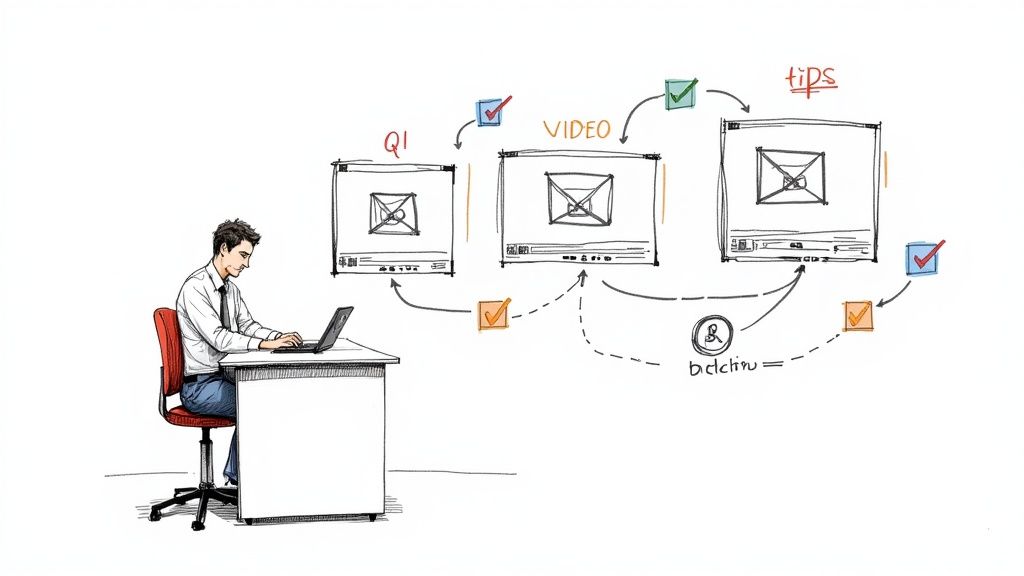
This is where asking the right questions, right from the start, becomes your secret weapon. Using a tool like asynchronous video interviews lets you standardize your initial screening and dig deeper, much earlier. You can ask every single candidate the tough questions that reveal their true nature.
For instance, this is how we at Async Interview help you get a much clearer picture from the very first step. (Toot, toot!)
By having candidates record their answers, you see how they think on their feet. It’s an incredibly rich source of data that a flat resume could never provide. This small upfront investment of time and tech pays for itself tenfold by weeding out poor fits before you’ve wasted hours on live interviews.
And while learning how to effectively collaborate with recruitment agencies is smart, remember: it's still your job to own the screening process and make sure they're looking for the right cultural signals, not just warm bodies.
Screen for Competencies, Not Just Keywords
So, what do these "right questions" actually look like? They're behavioral and competency-based. Instead of asking, "Do you have experience with X?"—which just gets a "yes" or "no"—you force them to tell a story.
Here are a few examples that reveal so much more than a resume ever could:
- To test resilience: "Tell me about a time a project you were responsible for failed. What happened, what did you do, and what did you learn?"
- To test motivation: "Looking at our company's mission, what specifically caught your attention? How does it connect with your personal career goals?"
- To test teamwork: "Describe a time you had a significant disagreement with a colleague. How did you approach it, and what was the outcome?"
These questions don't have a simple right or wrong answer. They reveal how a person thinks, solves problems, and handles pressure. For more on this, check out our guide on building a competency framework. It’s the playbook for making sure every hiring manager is screening for the same critical traits.
Ultimately, slashing your turnover rate is an act of prevention. Stop letting people with one foot out the door get in. Be deliberate, be picky, and start screening for tomorrow’s leaders, not just today’s warm bodies.
Your Onboarding Is Broken. Here’s How to Fix It
You found a great hire. Congratulations. Now for the hard part: don’t blow it in the first week.
Let’s be honest for a second. Onboarding isn’t just handing someone a laptop, a Wi-Fi password, and a mountain of HR forms. That’s just provisioning. Real onboarding is your single best opportunity to prove they made the right choice in joining you.
A chaotic, disorganized first impression does more than just feel awkward; it plants the first seeds of doubt. It screams, "We don't have our act together." The path from great hire to early departure is brutally short, and it almost always starts with a bungled first week.
That timeline from new hire to former employee follows a painfully predictable script.

This is how a rushed start devolves into a poor fit, inevitably leading to their resignation within just a few months. A strong start is the single best predictor of a long tenure. It begins by getting onboarding right.
The $500 Welcome That Prevents a $50,000 Goodbye
That first week is make-or-break. New hires are sizing everything up, analyzing every interaction, trying to figure out if they've just made a huge mistake. It’s shocking how many companies, even big ones, completely fumble this critical period.
Think of it as a simple investment. You can spend a few hundred dollars on a thoughtful welcome kit and a team lunch now, or you can spend $50,000 replacing them in six months. The math isn’t that hard. A structured, welcoming first week isn't a "nice-to-have"—it's a powerful retention tool.
Here’s what that looks like in the real world:
- Day one is not for paperwork. It’s for making them feel like they belong. Their desk is ready, their accounts are active, and their manager is there to greet them personally.
- A planned-out first week. Don't leave them stranded. Schedule lunches with key teammates, 1:1s with their manager, and intros to people they'll work with across the company.
- Assign an onboarding buddy. This isn't their manager. It needs to be a peer who can answer the "dumb" questions they're too nervous to ask their new boss. Where's the best coffee? How does the expense system really work?
The goal of the first week is not productivity; it's connection. You're aiming for your new hire to go home on Friday thinking, "Okay, I made the right choice. These are my people."
Beyond the First Week: A 90-Day Onboarding Playbook
A great first week is a solid start, but the real work of integration happens over the next three months. A well-structured 90-day plan is what transforms a nervous newbie into a confident contributor. This isn't micromanagement; it's giving them a clear roadmap to success.
This plan should be a living document you create with your new hire, focusing on three key areas.
First up: Clear Performance Goals. Define what a successful 30, 60, and 90 days looks like. These should be small, achievable wins that build momentum. Think "successfully ship one minor feature," not "reinvent our entire product."
Next: Cultural Integration. Help them build their internal network. Map out the key people they need to know to get things done and then personally facilitate those intros. This is how you embed them into the company's social fabric.
Finally: Regular Check-ins. Weekly 1:1s with their manager are non-negotiable. These aren’t just status updates; they are dedicated feedback and alignment sessions. Ask good questions like, "What's one thing that surprised you this week?" and "Where are you feeling blocked?"
Building a structured plan from scratch can feel daunting. For a more detailed guide, you can review our complete hiring process checklist, which includes templates for building out your own 90-day onboarding journey.
It's time to stop treating onboarding as an administrative chore. It’s the most important retention strategy you have. Get it right, and you won’t just reduce turnover; you’ll build a team of advocates who are committed for the long haul.
It's Not the Money (Okay, It's a Little Bit the Money)
Sure, you have to pay people what they're worth. Let's just get that on the table. If your salary ranges are a lowball offer, no amount of free granola bars or empty "we're like a family" speeches will keep good people from walking out the door.
But once you're paying competitively, money is rarely the real reason your best people leave. It's just the cleanest, simplest excuse to give in an exit interview. The actual reasons are usually a lot messier, more personal, and almost always have their roots in your company culture.
This is where we get into the stuff that builds genuine loyalty—the things that make people want to stick around, even when a recruiter comes knocking. It’s about creating an employee experience that makes leaving feel like a major step down.
Recognition Is More Than Just a Bonus
To be clear, compensation is a huge piece of the puzzle. A recent talent retention report found that when 55.2% of employers offered raises and 36.7% provided bonuses, they saw voluntary turnover drop by a significant 17.1%. Paying people fairly is non-negotiable. You can dig into the complete turnover benchmark data from BambooHR to see exactly how pay affects retention.
But money is a short-term fix. Recognition is a long-term investment.
I'm not talking about some generic "Employee of the Month" plaque. Real, meaningful recognition is timely, specific, and often public. It’s a manager pulling someone aside after a tough project and saying, "The way you handled that client's objection was absolutely brilliant. Thank you." It’s a shout-out in the all-hands for the person who stayed late to help a coworker hit a deadline.
Recognition is the most underrated retention tool you have. It costs almost nothing and delivers a massive return by making your top performers feel seen. Employees who feel genuinely recognized are twice as likely to stay.
Here’s a simple playbook to get it right:
- Equip Managers to Give Praise: Train your leaders to spot and celebrate small wins. Give them a small discretionary budget for things like spot bonuses, team lunches, or a good bottle of wine.
- Foster Peer-to-Peer Recognition: Set up a system for employees to praise each other. A dedicated Slack channel or a regular segment in your weekly meeting works wonders.
- Link Recognition to Company Values: When you praise someone, connect their action back to a core company value. This doesn't just reward the person; it reinforces the culture you're trying to build.
Your People Need to Grow or They Will Go
Here’s a tough pill to swallow: ambitious, talented people will not stick around in a dead-end job. If they can’t see a clear path forward with you, they will find one somewhere else. A lack of career development is consistently one of the top reasons great employees quit.
The same retention report that highlighted pay also found that organizations focusing on professional development managed to slash their turnover by 25%. That's no accident.
This doesn't mean you need a rigid, old-school corporate ladder for every role. That model is broken. What you do need are visible growth opportunities.
This could look like:
- Skill Development: Offer a yearly stipend for courses, conferences, or certifications.
- Mentorship Programs: Pair up-and-coming employees with senior leaders who can offer guidance.
- Internal Mobility: Make it not only possible but encouraged for people to move between teams to learn new skills.
Stop thinking about career paths as a straight line up. Picture them as a jungle gym—people can move up, sideways, or even diagonally, as long as they feel like they’re making progress. Have candid conversations. Ask them, "What do you want to learn next?" and then help them get there.
Flexibility Isn’t a Perk; It’s a Requirement
The 9-to-5, five-days-a-week office mandate is on its deathbed. If you're still clinging to it, you're practically pushing your best people toward companies that trust adults to manage their own time.
True work-life balance has nothing to do with ping-pong tables or a keg in the breakroom. It’s about giving people the autonomy to do their best work in a way that fits their lives.
This means being genuinely flexible on:
- Where they work: Offer hybrid or fully remote options that work for the role.
- When they work: Ditch the rigid 9-to-5 for core hours and allow flexibility around them.
- How they work: Focus on outcomes, not hours clocked or whether someone’s status is green on Slack.
This isn’t a free-for-all. It's about setting crystal-clear expectations and then giving your team the freedom and trust to deliver. When you show your employees you trust them, they repay that trust with fierce loyalty.
At the end of the day, a competitive salary gets you in the conversation. But a culture built on recognition, growth, and flexibility is what convinces your best people to stay.
What Gets Measured Gets Managed

Let's be honest. Vague goals like "improving morale" sound great in a slide deck, but they're useless in the real world. Why? Because you can’t act on a feeling, and you can't fix what you don't measure.
It’s one of the oldest rules in business, yet the first one companies forget when it comes to their people.
If you’re serious about reducing staff turnover, it’s time to stop treating retention like some abstract art form and start treating it like a science. That means getting pragmatic and digging into the numbers. "Reduce first-90-day turnover by 15%" isn't a wish—it's a target you can build a strategy around and actually hit.
From Vague Hunches to Hard Numbers
Stop flying blind. Most leaders only spot a retention problem when a star player quits, but by then, the damage is done. Your own HR systems are a goldmine of data that can tell you exactly where the fires are starting, long before you see the smoke.
The trick is knowing which numbers truly matter. You need a dashboard—a simple, no-fluff set of metrics giving you a real-time pulse on your organization's health.
You can get an incredible amount of insight from just three powerful KPIs:
- Voluntary Turnover Rate (by team): Are people leaving the company, or are they fleeing a specific manager? Slicing your turnover data by department or team lead answers this question almost instantly.
- First-90-Day Turnover: If this number is high, you have a problem with your hiring or onboarding process. Full stop. It’s the ultimate red flag that you’re either hiring the wrong people or setting them up to fail.
- Employee Net Promoter Score (eNPS): It all boils down to one question: "On a scale of 0-10, how likely are you to recommend our company as a place to work?" It’s a fast, surprisingly effective way to gauge overall sentiment.
You don't need a hundred different metrics. You need a handful of vital signs that tell you whether your organization is healthy or bleeding out. Start here.
Benchmarking Against the Real World
So, you have your numbers. The next question is: are they any good? Context is everything. According to Mercer's recent US Turnover Survey, the average voluntary turnover rate hovers around 13.0%. But averages can be incredibly misleading.
For instance, the Retail and Wholesale industry is bleeding talent at a staggering 26.7%, while the Insurance sector sits at a much more comfortable 8.2%. The data also shows that companies which invested in genuine flexibility and clear career paths saw turnover drop by up to 20%. You can discover more about how industry and strategy affect turnover rates in the full report.
Knowing your industry benchmark gives you a realistic target. If you’re in retail, aiming for an 8% turnover rate is a fantasy. But cutting your rate from 27% to 22%? That’s a massive, achievable win.
Stay Interviews Not Exit Interviews
Let me be blunt: exit interviews are mostly a waste of time. People are rarely 100% candid on their way out, and even when they are, the feedback comes far too late. The real gold is in stay interviews.
These are proactive, informal conversations with your current top performers—the people you absolutely can't afford to lose. You ask them simple, direct questions:
- "What do you look forward to when you come to work each day?"
- "If you were in my shoes, what's one thing you would change about our team?"
- "What keeps you here?"
This isn’t a performance review; it's a gut check. It’s a conversation designed to uncover what’s working and what isn’t, giving you actionable feedback before someone even thinks about updating their LinkedIn profile.
Building a system to track all this might sound daunting, but it doesn't have to be. To get started, check out our guide on creating a recruitment metrics dashboard—the principles can be easily adapted for retention. It's time to stop guessing and start managing.
Your Burning Questions, Answered
Alright, we’ve covered a lot of ground. You're probably buzzing with ideas—or maybe just feeling a little overwhelmed. Both are normal. When you start pulling at the threads of staff turnover, you realize it's connected to everything.
Let's cut through the noise. Here are some straight, no-fluff answers to the most common questions I get from other founders and leaders trying to stop the revolving door for good.
What Is a Good Staff Turnover Rate?
Honestly, anyone who gives you a single "magic number" is selling you snake oil. A "good" turnover rate is wildly different depending on your industry. If you're in retail, you're living in a different universe than someone in the insurance sector.
- Tech & Retail: These sectors are hyper-competitive. Rates between 15-25% are common, and while that sounds high, it's the reality of the market.
- Government & Insurance: These industries are much stickier, often seeing turnover rates under 10%.
Here’s the only answer that matters: a "good" rate for you is one that is consistently trending downward. Stop obsessing over a national average and start benchmarking against your direct competitors and, more importantly, your own historical data. If you can knock your specific turnover rate down by 20% year-over-year, you’re not just doing well—you're winning.
How Can I Reduce Turnover With a Limited Budget?
This is my favorite question because it forces you to get creative. Throwing money at the problem is easy. Building a culture that people don't want to leave? That takes real effort.
Forget big, expensive perks. Start with the free stuff, which is often the most powerful.
Public recognition in team meetings. Crystal-clear communication from leadership. Conducting 'stay interviews' to find out what your top performers love about their jobs. These things cost you nothing but time and deliver a massive ROI in loyalty.
Once you’ve nailed the freebies, you can move on to low-cost, high-impact benefits. This is where you get the most bang for your buck. Think about offering:
- Genuine work flexibility (which is free, by the way).
- Documented career paths so people can see a future.
- Mentorship opportunities that connect junior staff with senior leaders.
Remember, an ounce of prevention is worth a pound of cure. Investing a little time into improving your hiring and onboarding costs far less than replacing even one bad hire. For a more in-depth look at this critical topic, you can explore additional effective strategies to reduce employee turnover that cover a wide range of budgets.
How Quickly Can I See Results from These Strategies?
You’re not going to fix a deep-seated retention problem overnight. But you’re also not going to wait a year to see progress. The results will come in waves.
Some changes have an almost immediate impact. By tightening your hiring process to screen for culture fit, you can see a noticeable drop in early-stage (first 90 days) turnover within a single quarter. That’s a quick win that proves your efforts are working.
Other initiatives take more time to bear fruit. A structured, engaging onboarding program will likely show a positive impact on your six-month and one-year retention rates. You're building a stronger foundation.
The biggest changes, like overhauling management training or fundamentally shifting your company culture, are a longer game. These are the 12-to-18-month projects. The key is to start with the quick wins to build momentum and get the buy-in you need to tackle the long-term, foundational shifts.
Are Exit Interviews Actually Useful?
They can be, but they’re often too little, too late. Let’s be real: people are rarely 100% honest on their way out. They want a good reference, they don’t want to burn a bridge, and they’re already mentally checked out. You’ll get polite, sanitized feedback that isn't particularly useful.
The real gold is in "stay interviews."
These are proactive, informal conversations with your current top performers—the people you absolutely cannot afford to lose. You’re asking what’s keeping them here, what they love about their work, and what might tempt them to leave. This gives you actionable feedback from the exact people you want to keep, long before they even think about polishing their resume.
Use exit interviews to spot broad trends. If you hear the same complaint about a specific manager from five different departing employees, you’ve got a problem. But use stay interviews to get ahead of the curve and prevent those exits from ever happening.
Fixing turnover isn't about a single magic bullet. It’s about being better at hiring, better at onboarding, and better at creating a culture where great people want to grow. The good news is that tools exist to make the first part—hiring—radically more effective.
Async Interview helps you screen for the right fit from day one, cutting down on those costly mis-hires that fuel your turnover rate. Ready to stop the churn and start building a team that sticks? Learn more about how we help you hire smarter, not harder.